HV principal Maxi Pethö-Schramm added that long-duration energy storage (LDES) is essentially for meeting the future energy demands of AI data centres “while providing European industry with affordable, reliable baseload power.”
“Only then will Europe have the means to compete in the complex, energy-intensive sectors that will define the continent’s future,” Pethö-Schramm said.
The technology is similar in principle to the iron-air batteries developed across the Atlantic by US startup Form Energy, which emerged from stealth mode in mid-2021. Form’s technology also uses the reversible rusting of iron as the core storage mechanism.
Trading off RTE for cost
Like Form, Ore Energy claims its battery is made using only abundant, low-cost materials, with the principal ingredients being iron, water and air. Both companies claim their batteries can therefore be manufactured using local supply chains almost anywhere in the world and are decoupled from existing lithium battery supply chains.
Both also claim their technologies to be suitable for multi-day durations of storage, in the range of around 100 hours, at far lower cost than lithium-ion (Li-ion) battery energy storage systems (BESS).
In a March article for ESN Premium, freelance tech journalist Liam Critchley compared the publicly revealed on-paper specifications and claims of three ‘100-hour storage’ technologies: from Form Energy, Ore Energy and another US startup, Noon Energy, which produces a storage system based on a solid oxide fuel cell architecture.
The multi-day storage (MDS) technologies are not designed to compete with Li-ion, as they have lower round-trip efficiencies (RTEs), but their ability to slowly deliver energy over days at low cost could make them a valuable grid asset for filling gaps during extended periods of low renewable energy output.
Critchley wrote that while the companies have not publicly revealed certain metrics such as energy density, the theoretical energy density of an iron-air battery is around 1,200Wh/kg, which is more than double the theoretical energy density of various Li-ion cell types. Both Form Energy and Ore Energy are targeting costs of under US$20/kWh.
Iron-air commercialisation faceoff
Form Energy is further ahead of Ore in both commercial rollout and fundraising: the US startup has raised well over a billion dollars to date, including a US$405 million Series F funding round closed in October 2024.
Form built its first pilot project earlier that year, having already begun construction of its first US factory site in West Virginia. Since then, it has also won deals, including a 30GWh project with Minnesota utility Xcel Energy, which will supply a Google data centre campus.
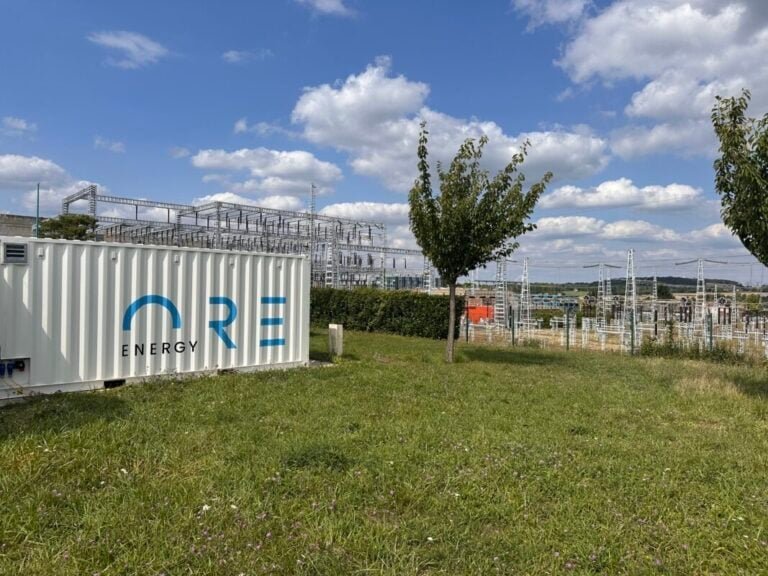
Ore Energy, meanwhile, completed its second grid-connected pilot project earlier this year, with a 100-hour system deployed at an EDF-owned lab in France. The pilot was supported by the EU’s Storage Research Infrastructure Eco-System (StoRIES).
Then, in June, Ore Energy signed an agreement with Dutch utility Budget Thuis to deploy up to 1GWh of its iron-air batteries, beginning with a 400MWh first phase to be delivered in 2028.
The company said the latest Series A funding will enable it to establish its first manufacturing facility. Ore aims to reach gigawatt-hour-scale manufacturing in 2028, with the initial facility to validate its manufacturing at scale.
“Expensive energy is the biggest barrier to growth, something European businesses and politicians know only too well. Affordable, renewable baseload power is the foundation for the next generation of manufacturing, AI infrastructure and industrial growth globally,” Ore Energy CEO and co-founder Aytac Yilmaz said.