He claimed Enexya both fills in the gap in the market from Chinese OEMs and is also ready to localise production if EU controls on Chinese BESS are introduced.
Gap in the market
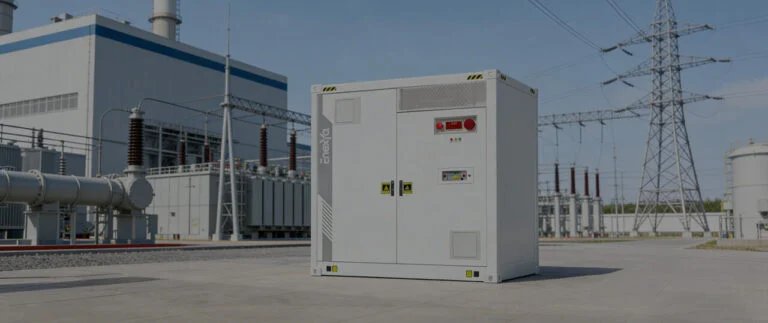
Its QubM product is for C&I applications while its 2.34MWh, 10-foot QubX container unit is for grid-scale applications, but at the smaller end of what we at Energy-Storage.news would typically cover. It uses 588Ah lithium iron phosphate (LFP) cells.
“We’ve designed a product range which we think corresponds to what customers in the C&I and small utility-scale space are looking for but can’t find in the market,” Bersano explains.
“If you look at the products from Chinese manufacturers, they mainly offer this all-in-one cabinet around 260kWh with PCS included or large, 20-foot containers of 5MWh+. But if you want to install something in between, this doesn’t really exist today,” he claimed.
“So your solution is either putting loads of the small cabinets together which is an issue in terms of reliability and maintenance or you buy a large container but most likely you’ll have more energy than you need.”
He said that most European customers already have a PCS manufacturer they work with, lessening the rationale of an AC block solution.
It won its first project in French Polynesia for three units totalling 7.5MWh, in what Bersano described as a ‘very technically difficult project’. And, it won against Huawei, which he said ‘confirms our bet the market wants these kinds of products’.
European manufacturing
For now, however, the company does still primarily manufacture in China. Bersano said that customers in Europe do want local products, but generally aren’t willing to pay more than about 10% above what they would for Asian products.
So Enexya manufactures its BESS units in China which is 80% standardised, with the remaining 20% customisation done in Europe. That could be adding inverters, changing the configuration or programming of the container, and most importantly adding the energy management system (EMS). The EMS is designed and built in France.
But does he see the possibility of a need to shift even more of that manufacturing to Europe?
“Not at this stage because there is no limitation from the EU when it comes to manufacturing in Europe. But what I think will change is that the PCS ban, I think the same will happen for the batteries. We have the possibility to be able to produce the battery packs and battery management system (BMS) in Europe. We don’t do it today, but we think we could do that within nine months if we needed to,” he explained.
He pointed out that the second PERTE tender in Spain for storage grants, finalised late last year, was an interesting one to observe from the point of view of local manufacturing.
It was open to different levels of locally manufactured products. The first 20% or so was to any supplier, the next 50% was for product with at least one component manufactured in Europe, while the strictest criteria require the entire product to be built in Europe, Bersano explains (giving rough percentages). The only companies that managed to qualify for the latter were second life energy storage companies, he said.
“I think it was a clever way to do it, because the question is: where you draw the line between European product and non-European product?