Solar PV is known as being one of the quickest energy sources to deploy to the grid. Despite that speed, there is still some time spent waiting to proceed to each step. If it was a race, solar construction could still be considered a marathon — with a few hurdles thrown on the track.

Credit: Obodo Energy Partners
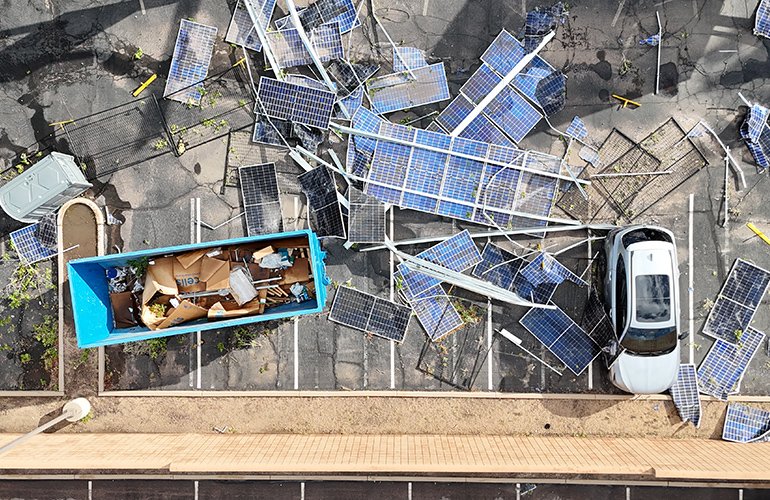
Arizona energy services company Obodo Energy Partners was nearing completion of its own race when a freak accident moved the finish line. Days before turning over a solar carport project to the customer and utility, a microburst descended upon Tempe, leaving a 10-mile tornado-like path of destruction that included the solar project. Obodo Energy Partners (No. 253 on the 2026 Top Solar Contractors List) had to quickly assess the damage, determine fault and plan a rebuild.
“We had gotten it pretty much all complete. We were just waiting for the final steps to turn it over to the client when this freak storm hit,” said Chris Mejia, partner and chief development officer of Obodo Energy Partners. “No one could remember the last time a storm of this severity did so much damage. The prevailing wisdom was that this doesn’t happen here in Arizona. You don’t really think about being concerned with it or making plans for it.”
A microburst is a column of sinking air that forcefully spreads out, causing extensive damage at the surface. While Arizona does not experience tornadoes or hurricanes, the region’s hot and humid conditions during the summer’s monsoon season can contribute to microburst development. They’re sudden and unpredictable, and the October 2025 microburst that hit Tempe likely included straight-line winds exceeding 100 mph in a five-mile-wide path.

Credit: Obodo Energy Partners
The storm twisted purlins, broke solar panels and damaged security fencing. Foundations and columns survived the storm.
“[I]t was designed for 105-mph [winds] for safety,” said John Mitman, founder and CEO of Obodo Energy Partners. “We think it’s possible, given the extent of damage, that the whole area was likely in excess of 115 mph. It just shredded the structure. I’ve been doing these same exact systems for 20 years in Arizona, and this is the only time I’ve ever seen this level of destruction on a structure that was otherwise structurally complete.”
Within a half hour of the storm passing, Obodo was on site to ensure everyone in the surrounding area was safe. Then there was the difficult task of determining what to do next.
“My immediate reaction as the CEO was thinking risk mitigation. Right out of the gate, let’s figure out what the heck happened, what the nature of the fault is, who’s ultimately accountable,” Mitman said, noting that structural engineers documented everything to submit to insurance. “Our commercial liability insurance provider declared we were not at fault — it was not a situation where the system was installed improperly. But it did create a gap where the system had not transferred title to the owner yet for the purposes of being covered by their property insurance.”

Credit: Obodo Energy Partners
Ultimately, the customer was understanding of the situation and collaborated with Obodo to split the cost of repairs. Once replacement panels and other materials were acquired, the system was rebuilt quickly. This was the second carport installation in a six-project portfolio for the customer, and plans continued for the rest of the systems — but with one change. The customer asked that the remaining systems be over-engineered for high winds in an abundance of caution.
And Obodo made one small update to its own business — carrying special excess insurance, just in case.
“The client was very understanding. There were no accusations thrown back and forth, and there was no hostility or animosity on any side,” Mejia said. “It illustrated that when you have that relationship with a client and contractor, approaching situations from that collaborative space, you can really get things done efficiently and make sure the outcomes work for everybody. That’s a lesson I took away: you want to work with the right people, and you want to be the right person that people want to work with.”
This story was featured exclusively in our 2026 Top Solar Contractors issue. See the issue and full list of top U.S. solar installers here.