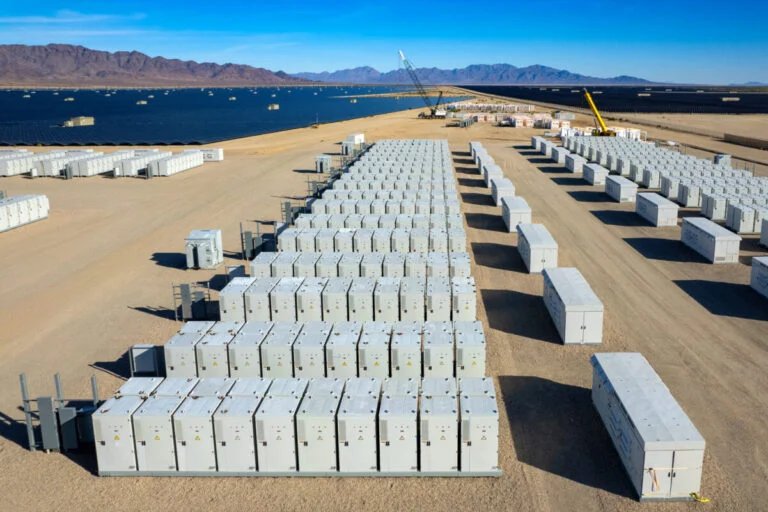
Some new battery technologies (such as sodium-ion, zinc, and solid-state lithium) have substantially wider acceptable operating temperature ranges (e.g., -30 °C to 70–100 °C). These chemistries could alter the design of future BESS with radically simplified thermal management or even enable fully thermally passive operation. Removing liquid coolant loops, eliminating HVAC dependency, and reducing thermal‑uniformity engineering at the rack and container level would streamline system design, shrink balance‑of‑system bill of materials (BOM), reduce operations and maintenance (O&M) needs, minimise water‑ingress vulnerabilities, and address major single‑point failures.
This represents a paradigm shift that could expand suitable deployment regions, improve availability, and transform BESS from “a collection of refrigerators in the desert” into passive and resilient grid assets
Why temperature dominates lithium-ion performance
The vast majority of BESS installations today are lithium-ion (primarily lithium iron phosphate (LFP) with some nickel manganese cobalt (NMC)). If they are:
- Too cold – Charging causes permanent lithium plating of the anode, degrading capacity, and potentially leads to dendrites, which can cause subsequent catastrophic failures.
- Mildly hot – There is accelerated degradation, a shorter useful life, and the need for earlier augmentation.
- Extremely hot – There is electrolyte breakdown/boil-off. The cell vents (which can include flammable, explosive gases) sometimes lead to thermal runaway and combustion.
In addition to environmental conditions, such as temperature and solar gain, battery cells also generate heat from round-trip-efficiency (RTE) losses. All of these need to be addressed by the thermal management system, which essentially functions as an air conditioner: it extracts heat from the battery and rejects it into the environment. Just like HVAC, the hotter it is, the more energy it consumes to reject the heat.
The BESS TMS load is typically bundled in with other minor operating loads, categorized as ‘auxiliary’ or ‘aux’ loads. A BESS generally creates value by shifting energy from low-price hours to high-price hours. These high-price periods are generally aligned with grid peak demands, which are primarily driven by commercial and residential HVAC loads on hot days.
Many regions require the aux load to be separately metered and often billed at a station service tariff rate, which may include time-of-use or even demand-charge pricing. In these instances, when BESS peak aux consumption is aligned with system peaks, the electric bill for the TMS can be severe.
The aux load can consume over 15MWh of electricity every year, for every MWh of BESS capacity. In 2025, about 50GWh of new BESS were installed in the US and about 40GW of PV. The energy required to power BESS HVAC systems equals the output of about 1 out of every 90 PV modules installed in the US that year.
By 2045, because PV production declines annually while BESS aux power needs increase, those same 2025 installations will consume the equivalent of 1 out of every 55 PV modules installed in the US in 2025.
BESS TMS designs are complex engineering feats, with the coolant loop often including over 200 compression liquid fittings, plus valves and chiller plates. All of these components are subject to potential risk of failure, which can result in a double short-to-ground fault and thermal runaway. The vast majority of LFP BESS fires have been liquid-induced shorts, and potential leaks of the battery coolant system present a risk similar to water ingress.
The TMS also represents the most frequent O&M activity needed by a BESS and TMS failure/underperformance can compromise project availability. A BESS TMS is often expected to have a shorter useful life than the project, requiring intrusive onsite replacements. The replacement requirement also exposes the project to supply chain and availability uncertainty, as the offerings of the HVAC market continue to shift.
While BESS modules are generally site-serviceable, replacing components can require disconnecting and reconnecting liquid fittings near electrical connections, as well as the partial draining and refilling of coolant loops. This introduces safety risk, increased subsequent fitting failure risk, and potential coolant contamination risk.
A BESS TMS typically takes up 10-15% of the BESS enclosure volume and accounts for over 5-8% of the system cost. As battery cell costs decline, the TMS will represent an increasing share of the capital cost. Simultaneously, as rising electricity rates and BESS market saturation shrink margins, auxiliary electric costs for BESS cooling will have a more significant impact on project economics.
The coming shift: wide-temperature technologies
Modern BESS TMS are substantially superior to prior iterations. A lithium BESS can be well designed to operate for years. However, given the above, the opportunity for a simplified or passive BESS TMS is substantial.
Recent developments should give the market hope that fully passive and/or substantially simplified BESS TMS are on the horizon. Manufacturers are now promoting wide-operating-temperature battery systems. For example, Peak Energy has launched a nearly passive, MWh-scale sodium-ion battery (-40C to 55C) in the US for grid-scale applications. Other examples include: sodium-ion (CATL Naxtra -40C to 70C, Hithium N162Ah -40C to 60C), solid-state lithium-ion (e.g. Donut Labs -30C to 100C, AESC -40C to 80C), and others (e.g. Eos zinc-ion -20C to 50C.
A passive TMS can mean no pumps, no fans, reduced capital expense (Capex), supply chain risk, operating expense (Opex), auxiliary engineering, procurement, and construction (EPC) designs, auxiliary consumption, in addition to improved asset availability and safety profile.
Fully accounting for the benefits of passive BESS may enable new battery chemistries to become competitive. While scaling these new technologies to compete with the mature LFP market remains a monumental challenge, their reduced cooling requirements provide a distinct economic edge.
This author expects LFP to remain the BESS chemistry-of-choice for several years to come. However, the potential for a fully passive TMS warrants holistic consideration beyond a simple Capex or Opex review.
About the Author
William Lauwers is head of technology, battery energy storage, for Enertis Applus+, a provider of technical consulting, engineering and quality control services in the renewable energy and energy storage sectors. He supports client-independent engineering and consulting analytics services. His experience spans BESS paired with PV, microgrids, natural gas peaker plants, and standalone storage systems, including some of the largest BESS projects in North America. Lauwers holds a B.S. In Mechanical Engineering from Worcester Polytechnic Institute and an M.S. in Materials Engineering from the University of Dayton.