For more than a decade, a racking company from Buffalo, New York, has been supplying the rooftop solar market with a device that simplifies panel-to-panel bonding. Millions of these clips have been snapped onto neighboring module frames found in commercial and residential solar arrays to electrically bond these systems.
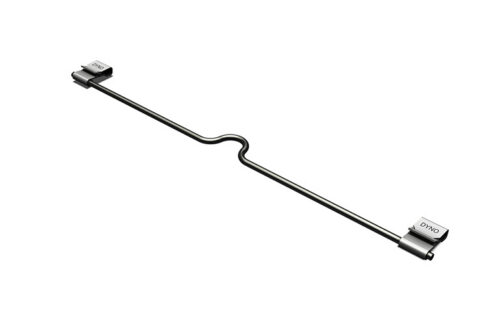
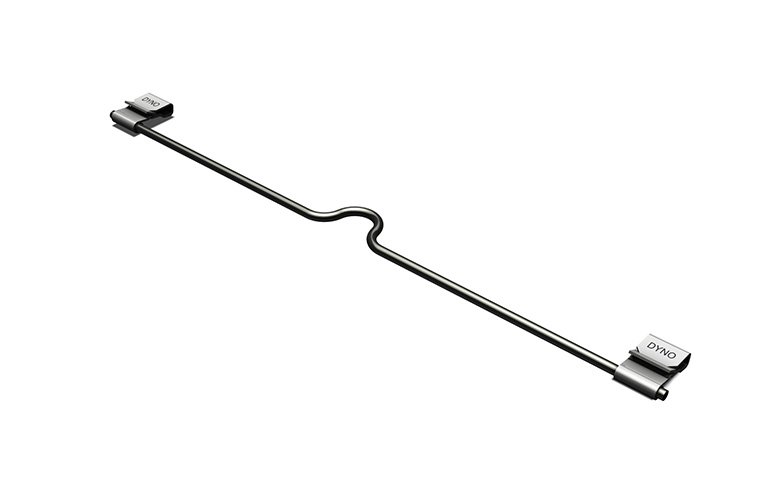
A rendering of DynoBond, DynoRaxx’s panel-to-panel bonding clip. Credit: DynoRaxx
The product is known as DynoBond, and DynoRaxx invented it to solve an in-house electrical bonding problem. But after all these years, DynoBond has become its most prolifically produced component based on individual units produced and sold.
DynoRaxx is known for its non-conductive fiberglass racking. These structures were designed with ease of installation in mind, featuring essentially two components: the rack itself and attachment clamps. DynoRaxx applied the same design sensibility to DynoBond, which is a length of copper wire covered in a tin coating and with stainless steel-brackets attached on either end. The clip installs by pressing each bracket onto neighboring module frames by hand, and doesn’t require tools.
“Since our system is fiberglass, we needed a mechanism that was easy to install for that equipment grounding,” said Nathan Rizzo, CEO of DynoRaxx.
Solar module frames, which are mostly made of metal, are electrically conductive. On a metal racking system, that electrical bond between solar modules can be established and then grounded into the racking itself. There’s a risk of electrical shock if a solar project isn’t properly grounded, which could be dangerous and possibly fatal.
While viable for bonding ground mounts, DynoBond is primarily used in the rooftop market.
A common method for grounding a rooftop solar project is installing grounding lugs on each solar module frame and running a copper wire through those lugs in the panel row. Segments of the wire are secured in the lug and ultimately tied into the racking to ground the system.
DynoBond is an alternative to using grounding lugs on each frame. The clips’ brackets use a toothed spring clamp that clings to the bottom lip flange of a solar module frame. They can be installed in module rows going east-west or north-south — often using both orientations to bond modules in a single solar array. Then to terminate the electrical charge, DynoBond can either be led to a junction box or a homerun wire leading away from the array.
“Our goal is always to reduce installation cost, whether that’s through our mounting system or through the DynoBond,” Rizzo said. “Everything is user friendly from a component perspective. We try to keep our part counts as low as possible.”
From internal to widespread use
DynoBond was first deployed exclusively on solar projects using DynoRaxx racking in the early 2010s. It was initially designed to solve that internal conductivity problem, but eventually DynoRaxx started selling the bonding clips to other solar installers and they have even been packaged with competing racking systems.
Getting to that point required marketing DynoBond from the ground up. At trade shows, the company started handing out samples of the DynoBond and still does today. It was advertised as an racking-agnostic component to be used on pitched and flat roof solar projects.
“It took a few years for somebody to really understand the value of DynoBond,” said Scott Lewandowski, sales manager at DynoRaxx.
AHJs also took a few years to understand DynoBond as a component in solar systems. At the start, permitting offices were frequently contacting the company with questions, but those inquiries have tapered off more recently, Lewandowski said.
While it is a smaller component on solar projects, DynoBond is manufactured in the United States using domestic metals.
“All DynoRaxx components have been American made since day one,” Lewandowski said. “The wire, the smelters, our stainless steel are all American-sourced and American-made.”
They come in lengths anywhere from 8 to 96 in. And an installer can place DynoBonds on 50 kW of solar modules within an hour, he said.
“It’s such a small product. The packaging, the shipping. It’s not something that’s overwhelming,” Lewandowski said. “You can put it in the front seat of your car, go to the job site and be out of there within the hour … There are no specialized tools. As long as a guy has two hands, he’s good to go.”
After more than a decade, DynoBond’s design hasn’t really changed, but it continues to find new uses. Recently, it’s been gaining traction in solar project repowering. DynoRaxx plans to continue producing this little bonding clip for the broader solar market, for whoever may need it.