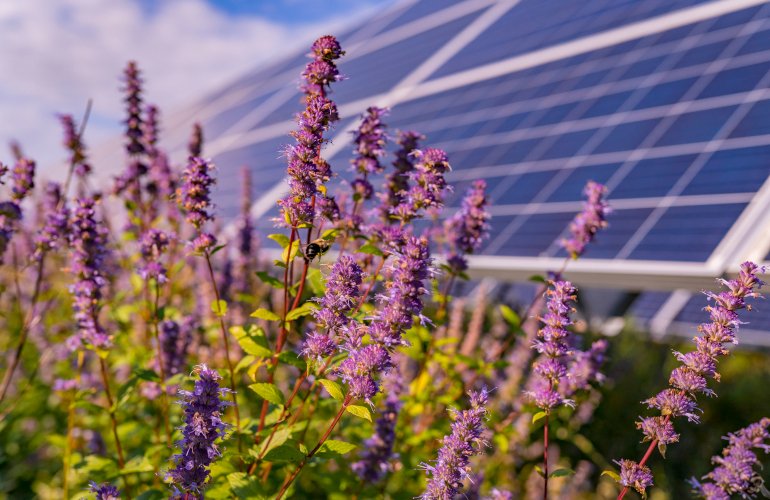
Nearly every utility-scale solar site in the country has vegetation that requires management. That requirement is usually treated as a one-way line item on the operations budget — but it doesn’t have to be. The most effective answer the industry has found is also the one that builds community trust, supports the local environment and turns a project into a shared asset.

Enel North America
Dual-use solar, whether that means sheep grazing, beekeeping, pollinator habitat, shade-grown crops or some combination, has evolved from a sustainability experiment to something closer to standard operating practice for developers and operators wanting projects that work for the land and the people around them.
Earth Day 2026’s theme, Our Power, Our Planet, makes the case that environmental progress comes from the daily work of communities, workers and local partnerships rather than from any single policy or announcement. That’s a useful frame for dual-use solar, because the work happens project by project and partnership by partnership.

Enel North America
The decision to pursue dual-use solar has to be made early, before a site is permitted and sometimes before it’s fully designed. The assessment starts with the land itself: vegetation profile, regional climate, native species already in play and what the surrounding community cares about. Climate is often the deciding factor for what’s possible. A site in Texas can support year-round sheep grazing because vegetation grows through the winter, and sheep can stay on-site. A Minnesota site can support sheep, too, but cold winters require a different setup.
Planning dual-use solar also carries a benefit that’s easy to underestimate. The commitment to manage the land for more than just power generation improves community acceptance. Landowners, local leaders and permitting bodies respond to the distinction between a project that takes land out of use and one that puts it into a second, productive use. That difference can accelerate a project’s development, and for developers facing skepticism about land-use conversion, it’s one of the few tools that reliably works.
The conditions that rule out dual-use are narrow. Without vegetation, there’s nothing for sheep to graze. Without flowering foliage, there’s nothing to support beekeeping. Those are real constraints in arid regions. Everywhere else, the question is which form best fits the site.
Finding the right partner
Partner selection tends to follow two paths, depending on whether the work is a paid service or a mission-driven initiative.

Enel North America
Service providers, like sheep grazing operators or vegetation management crews, come through standard procurement channels. The wrinkle is that in an early regional market, the providers don’t always exist yet. When Enel deployed its first U.S. sheep-grazing project in Minnesota, it was also the first solar-grazing contract for the provider that won the work. Both sides learned together: The grazing company learned solar, the operator learned animal husbandry and the relationship has continued for years. That kind of co-education is common when dual-use enters a new region, and it’s a reminder that the winning bid isn’t always the one with the deepest existing track record. Sometimes the right partner is the one willing to build capability alongside the project.
Mission-aligned partners follow a different process entirely. Instead of starting with a service the project needs, the operator starts with a question: What do residents care about, and what can a solar site offer that nothing else can? That’s the logic behind partnerships like the one Enel has with Hives for Heroes, a nonprofit that brings veterans and first responders into beekeeping to support mental health and community reintegration.

Enel North America
One of Hives for Heroes’ biggest structural barriers is land access — it needs places for hives, and hives need pollinator forage. Enel’s Texas sites have thousands of acres planted with pollinator and native grasses. Both organizations’ missions help solve the other’s problem. Local beekeepers in the network will now also visit FFA chapters and schools to talk about beekeeping on solar sites, pushing impact well past the fence line.
There’s a real return on that kind of partnership. Research conducted by the National Renewable Energy Laboratory and Argonne National Laboratory at three solar sites in Minnesota tracked insect communities and flowering plants over five years and 358 field surveys. Total insect abundance tripled. Native bee abundance increased twentyfold. The study also found that bee visitation to soybean fields adjacent to the solar sites was comparable to that in soybean fields next to Conservation Reserve Program grasslands and higher than in the interiors of those same soybean fields. In other words, dual-use solar doesn’t only support pollinators on the project site — it makes the farms next door more productive, too. For developers having the community conversation, that’s a different argument than the one most people are used to hearing.
Vegetation plans have to be matched to whatever dual-use is being pursued — native grasses and low-growing species for a grazing site, pollinator-friendly forbs for a beekeeping site, and good soil and climate characteristics for growing shade-friendly crops under panels. Herbicide and pesticide programs also have to be coordinated with things like beekeeping schedules so hives aren’t exposed to chemicals. Site teams need training on what to expect when sheep first arrive on a project, which is why organizations like the American Solar Grazing Association have become essential infrastructure for the industry. The support structure inside the company has to match the ambition of the partnership outside it.
What’s changing
A decade ago, sheep on a solar site was novel enough to count as out-of-the-box thinking. That’s no longer the case. U.S. agrivoltaics sites went from about 27,000 acres producing 4.5 GW in 2020 to roughly 60,000 acres producing 10 GW by late 2024, with nearly 600 sites now operating. Industry associations have formed. Dedicated providers are scaling up. Research institutions are documenting long-term outcomes that will shape how the whole sector approaches site design.
Dual-use solar started as an experiment and has become a discipline. On Earth Day, that’s worth recognizing as a concrete example of what “Our Power, Our Planet” looks like in practice.