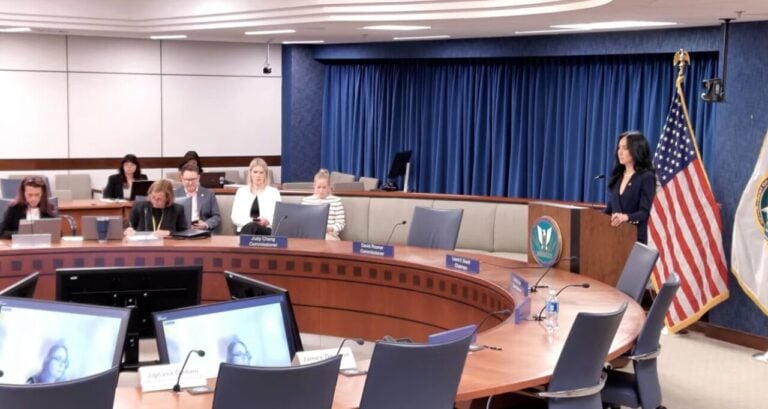
They must either provide justification explaining why their current tariffs remain just and reasonable in the absence of clear and consistent provisions for large load customers, or alternatively propose changes.
“What the show cause orders are telling us is that there is an underlying concern about the integration of large loads across markets—there’s a perceived risk of those costs being borne by other ratepayers,” says Raafe Khan, head of energy storage and emerging markets at Camelot Energy Group.
The orders support the Secretary of Energy’s advance notice of proposed rulemaking (ANOPR) to expedite the integration of large loads onto the transmission system, which is intended to, as FERC wrote, “support the innovation economy, lead the global AI race, and reshore manufacturing jobs to the US.”
Five reform categories
FERC has proposed five categories of reforms that grid operators must address:
- Developing efficient transmission service application and study processes, including consideration of alternative transmission technologies.
- Preventing cost shifting and requiring transparency into transmission costs.
- Accommodating co-location arrangements and behind-the-meter generation.
- Providing new transmission services for flexible large loads.
- Developing a process to study generating facilities serving electrically proximate large loads and large co-located loads.
Khan notes of FERC’s approach, “They’re trying to be firm with what they’re looking for with respect to the outcome, but they’re also being thoughtful about telling the RTOs and ISOs what they need to do.”
“They’re basically encouraging study processes that reward technologies that have more of a deflationary impact on power pricing—things like batteries, virtual power plant (VPP) programmes, and different passive and active devices that can be installed at a relatively lower cost.”
Timeline
The orders establish a defined timeline for compliance. Grid operators have 21 days from the 18 June order (until 9 July) to intervene formally, must submit a detailed report by the end of July, and have until mid-August for tariff filings and show cause responses.
Within 30 days, RTOs/ISOs and their transmission owners must submit detailed information reports on how each intends to ensure adequate generation will be available to serve existing and new large loads.
These reports should include any proposals under consideration to address resource adequacy for new large loads, detailed schedules of key milestones, and any ongoing stakeholder processes aimed at increasing the pace of adding generating capacity in the region.
“I think some markets are ahead of others,” Khan notes. “SPP is kind of ahead of the game. PJM is tracking in parallel. MISO is experiencing the fastest growth in terms of data centre integration of any region. California is structurally distinct in terms of the way it operates, and then New York and ISO New England have a lower amount of urgency.”
Regional differences
FERC recognises that regional differences exist in the procedures and strategies implemented by grid operators and has designed the orders to reflect these variations.
SPP has developed its High Impact Large Load and High Impact Large Load Generation Assessment processes, which are expedited frameworks for serving large power demand from loads such as data centres.
FERC addresses co-located loads in PJM in a separate proceeding. Transmission service models differ significantly, including in CAISO, which does not offer traditional Order No. 888 transmission services.
The orders allow each RTO and ISO to define large loads and to create operational requirements particular to their region, while also accounting for regional differences on topics such as cost transparency, study processes, and network upgrades.
Energy storage’s expanding role
The orders also have implications for energy storage’s role in transmission planning and grid integration.
“I think the show cause order is sensibly about data centres, but really what it’s about is flexibility, and batteries are one of the few technologies that can make large loads connect faster, easier to manage, less expensive for the rest of the system,” says Oliver Kerr, managing director, North America at Aurora Energy Research. “What the show cause order does is provide clear guidance to ISOs for ways to enable storage to unlock the value of that flexibility.”
“I’m very curious to see how ISOs and RTOs embrace grid-enhancing technologies like batteries and dynamic line ratings and advanced conductoring to help bring costs down,” Khan says.
“With transmission costs ranging anywhere from US$1 million to US$5 million per mile of high voltage transmission, if you can mitigate that by using some of these other commercially available technologies, that’s going to cost less, be deployed faster, and allow more energy to be flowing through the grid.”
Khan discusses the potential for batteries in transmission planning, “I’m curious to see how batteries become—and we’ve talked about this a lot—storage as a transmission asset, and how storage becomes part of that overall transmission planning effort.”
He continues, “Because of the nature of batteries being able to charge and discharge strategically, that could open some new opportunities for battery-based developers and also opportunities on the grid to alleviate some of those congestions that we see in pockets of the grid.”
Enabling storage through reform
Kerr explains how the orders directly support energy storage integration, saying, “One of the challenges right now is, if you have an on-site battery at a data centre, that can reduce demand during peak hours. Grid operators essentially see data centres as a big network upgrade problem, and when they’re studying large load interconnection requests, they look at the maximum potential draw on the system, and then they need to size grid upgrades to that maximum potential.”
“What batteries on site allow you to do is, during peak times, reduce that maximum draw on the system, and that can reduce your effective demand,” Kerr continues. “One thing that this FERC order could do is encourage system operators to study both the load and the generation on site together and consider them as a package rather than as two separate things, and that can help projects get online quicker.”
Kerr also highlights the potential for new market products, “ISOs and RTOs might be asked to create new products to reward batteries for that, so instead of just playing in as energy arbitrage or ancillary services, they can be rewarded for load management and the transmission benefits they provide.”
Long-duration energy storage (LDES) considerations
While LDES has received attention in relation to large load integration, Khan notes that market evolution will be necessary to support its deployment.
“The challenge that we’ve had with LDES is that we haven’t had a market price signal,” Khan explains. “In markets like ERCOT, where you have plenty of one to two-hour batteries, the reason we’ve had so many batteries installed in that duration spectrum is because we had a price signal in the form of ancillary services. But for long duration—if you’re talking in the order of eight hours, 10 hours, or 12 hours—we don’t have a price signal that is incentivising that longer discharge.”
He continues, “The reason why the average duration of batteries today is four hours is not by accident—it’s purely because the market rewards you in that two to four-hour range.”
Despite these challenges, Khan sees potential for LDES. “Long duration, because of its ability to cover not just your peak load but even around the peak load, is certainly attractive. I think that’s going to be part of the overall planning process evolution.”
Kerr adds that the orders could support LDES deployment depending on implementation, “In general, this will encourage more data centres to have onsite generation that’s dispatchable. Batteries are one of the key technologies. Longer duration, depending on how the rules are designed, could favour longer duration assets and provide another revenue stream for them. It will depend exactly on how the rules are written. Do you need to be able to reduce your peak load for just an hour? Is it for a longer system stress event?”
He notes that hybrid approaches are already emerging, “One thing that we’re seeing right now is data centres pair batteries with gas as well, so that the battery can ramp up very quickly, and then you’ve got gas for longer periods of needed load reduction.”
Co-location
The orders address the growing trend of data centres co-locating with existing generation facilities, including nuclear power plants.
“FERC is asking the RTOs and ISOs to evaluate co-location of data centres with generators like nuclear, solar, and wind, and what rules they’re going to make for electrical proximity for these large loads,” Khan explains.
He notes, “FERC basically told all the ISOs and RTOs that they need to adopt preliminary definitions for co-located loads and arrangements for co-location, including behind-the-meter (BTM), and whether co-located loads interconnected below generators’ maximum output should take transmission service and how the demand charges should be allocated without having them transferred over to ratepayers.”
Kerr emphasises the importance of clear rules, saying “Right now, there aren’t very clear rules for what co-location looks like and how it should be treated by the grid. In asking ISOs to create clearer rules, I think it just provides a pathway to monetise the value of that flexibility that a battery can provide on site.”
This issue has become more relevant as hyperscalers sign capacity agreements with nuclear power plants to secure baseload power. “The problem is that if the load is going to be BTM to the plant, then all of that transmission cost shifts over to other loads, like residential loads,” Khan says.
“That’s not going to work, and that’s why I think this show cause order couldn’t come sooner, because we are seeing a lot of these hyperscalers trying to be co-located with these large generators that are already on the grid or have been retired and are coming back to life over the next few years, especially on the nuclear side.”
State authority
Notably, FERC’s orders do not affect the authority of states to select, site, and permit generating resources or the authority of state public utility commissions to set the rates, terms, and conditions of retail electricity sales.
The orders specify that while the Commission addresses cost shifting among transmission customers, states retain responsibility to ensure there is no cost shifting among retail customers.
The orders are not intended to disrupt existing agreements that large loads have negotiated or are in the process of negotiating for the provision of transmission service. The orders provide that RTOs/ISOs should allow a reasonable amount of time to finalise agreements that are nearing completion when any tariff revisions are filed with the Commission.
Market leadership
When asked which markets are best positioned to integrate energy storage into large load integration processes, Kerr points to ERCOT and SPP, “ERCOT is probably furthest along with this in their batch zero study process. It’s not actually covered by the FERC order, but they’ve already made a strong start, and I think they’re ahead of the game of the other markets. I think SPP is probably most advanced in terms of what it’s doing.”
He adds, “As a result of this order, all ISOs will have to think through the large load interconnection process and tariffs, and the general push is to encourage flexibility, and there just aren’t many ways that data centres can do that. Batteries are one of the key options for them.”
Kerr views FERC’s approach positively, noting, “FERC’s role here is not to dictate exactly how each ISO should do it, but just encourage them and really force them to adopt policies, processes, and rules that they didn’t have before. It really is those policies, processes, and rules that will be adopted at the ISO/RTO level that will enable the flexibility that batteries provide to be rewarded and broadly encourage flexibility for large loads. I think FERC has done its job. I think it’s a really solid order.”
Khan believes the grid operators have the information needed to respond within the timeline provided, “I think some markets are ahead of others, and they have a lot of the data. The ISOs and RTOs need to act fast because the data centre growth story cannot wait. Sometimes we see the technology comes first and regulation follows. This is very much the same way, where technology and regulation are kind of at odds a little bit, but I do believe that they have all the data that they need in order to make an informed decision.”