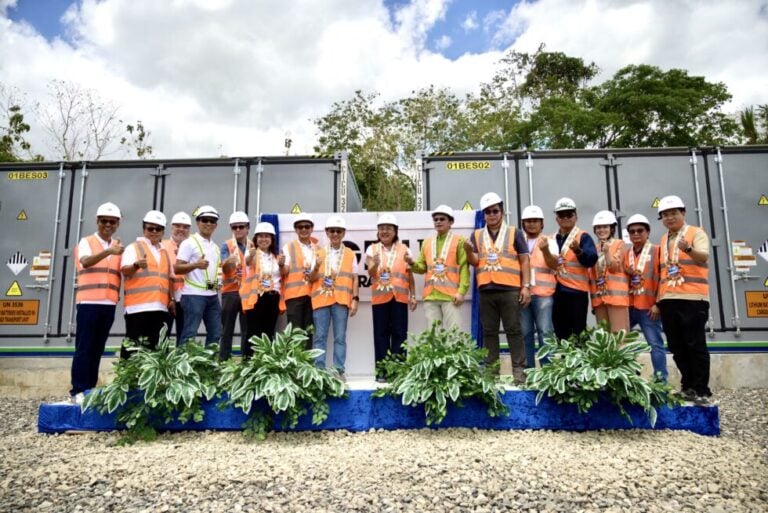
The system inaugurated last week represents the first completed phase of two that will total 49MW of output. MGEN announced the project in July of last year, noting at the time that the second phase is targeted for completion in 2027, although it remains subject to regulatory clearances, the company noted in last week’s announcement.
Developed by an MGEN regional thermal power generation subsidiary, Toledo Energy Development Corporation, the lithium-ion (Li-ion) BESS plant will integrate both renewable and conventionally generated energy into the Wholesale Electricity Spot Market (WESM) to support the Visayas grid at peak times and provide ancillary services.
MGEN president and CEO Emmanuel V. Rubio described Cebu as a “key demand centre in the Visayas,” and the energisation of the 25MW BESS as “an important milestone for the Visayas grid.”
The Visayas region is home to around eight million people and includes important economic and tourism hubs, while Cebu itself comprises the main island of Cebu City and 167 surrounding islands.
In March, Spain’s Acciona Energia Global broke ground on a 150MW solar PV plant (176MWp) in Cebu. The company’s Daanbantayan Solar Power Plant was fast-tracked for development by the Philippines national Board of Investments (BOI) in 2024, which issued it a Green Lane Certificate, the official endorsement that mandates expedited processing for Strategic Investments.
While the Philippines is among Southeast Asia’s leaders in renewable energy adoption, the BOI noted that Cebu lags behind other regions such as Metro Manila in this regard. The Acciona Energia project is expected to go into commercial operation before the end of this year.
Meralco’s Cebu project, meanwhile, marks the second large-scale battery project the electricity distribution company has embarked upon in the Philippines.
The first was the largest solar-plus-storage project announced in the world at the time construction began in November 2024, the ongoing Meralco Terra Solar (MTerra Solar) project in Gapan City, about 100km from Manila.
The Philippines’ president, Ferdinand Marcos Jr., attended a November 2024 groundbreaking for MTerra Solar. The project will eventually feature 3.5GWp of solar PV generation and 4.5GWh of BESS capacity. Its first phase, comprising 1.29GW of solar PV, was completed in February this year.
Pivotal time for Philippines energy sector
The latest project’s energisation comes as the Philippines government works to make it easier to facilitate investments in energy storage as an instrument of energy security and decarbonisation alongside renewable energy. While this has been an ongoing effort for a number of years, the current oil supply crisis may well give further impetus to clean energy investments in Asian countries dependent largely on imported fuels.
Recent developments reported by Energy-Storage.news include:
March 2025 – The DOE launches its first auction scheme to specifically call for renewable energy with integrated energy storage.
September 2025 – President Marcos Jr. inaugurates the first solar-plus-storage ‘baseload’ power plant in the country.
October 2025 – Speaking at the Energy Storage Summit Asia 2025 in Manila, the chair of the Philippines national regulator says forthcoming market rules for energy storage will be a “watershed moment” in defining the sector.
February 2026 – The new regulatory framework is passed by the Philippines House of Representatives.
February 2026 – The DOE instructs that all new renewable energy facilities over 10MW must integrate energy storage in their proposals.
Energy-Storage.news publisher Solar Media (part of the Informa Group) will host the Energy Storage Summit Asia 2026 on 1-3 July at QSNCC, Bangkok, Thailand. The conference takes place during ASIA Sustainable Energy Week 2026 (ASEW), the region’s most influential platform for driving clean energy. For more information, visit the official website.