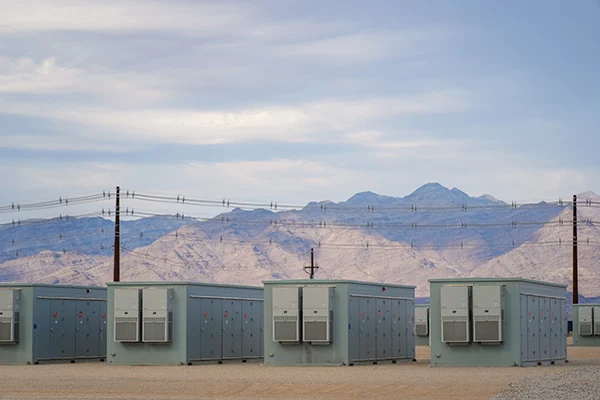
Northern Divide will receive regular battery enhancements to compensate for natural wear, without expanding its nameplate capacity. By the project’s completion, around 129 BESS containers and 43 power conversion systems (PCS) are expected to be installed within the current footprint.
The PCS converts direct current (DC) from the batteries into alternating current (AC) suitable for grid connection, with energy supplied from the grid through a shared collection substation and transmission line with Northern Divide Wind, LLC.
A key feature of the project is its strategic positioning alongside existing infrastructure. The facility will utilise Northern Divide Wind’s collection substation, transmission systems, and point of interconnection, with only minor updates needed, such as support structures, circuit breakers, reactors, fence expansion, and grading.
This strategy aims to reduce environmental impact and improve operational efficiency by concentrating development in a small area. The project has obtained a 24.5-year Energy Storage Agreement (ESA) with Basin Electric Power Cooperative, with energy delivered to the Basin Electric Cooperative Tande Substation through the existing 345kV transmission line.
Environmental assessment, safety measures, and regulatory compliance
The Commission’s approval followed what was described as comprehensive environmental and cultural resource assessments that demonstrated minimal adverse impacts.
An acoustic assessment verified that the highest expected noise level is 34 dBA at the closest receptor, which is 4,230 feet from the project site. This is significantly below Burke County’s limit of 45 dBA Ldn within 100 feet of occupied buildings.
The inventory of Class I and Class III cultural resources revealed no significant archaeological or historic sites impacted by the project, and this was confirmed by the State Historic Preservation Office in January 2024. Natural resources surveys also found no wetlands or waters within the project zone.
Additionally, no federally listed threatened or endangered species were spotted during field surveys, and there was no suitable habitat for species such as the northern long-eared bat, piping plover, rufa red knot, Dakota skipper, or whooping crane.
Safety features are vital to the project design, consisting of four protection layers within the BESS. Physical thermal barriers inside containers stop cell-to-cell spread. Meanwhile, a battery management system (BMS) constantly checks each container for unusual conditions in cell voltage, temperature, current, and ambient factors.
A fire alarm control panel detects smoke or gas in any container and activates alarms, while the Renewable Operations Control Centre continuously monitors the facility through the project’s supervisory control and data acquisition system. The construction will adhere to the International Fire Code, NFPA 855, the National Electric Code, and UL9540 safety standards.
Northern Divide stated it is dedicated to implementing comprehensive mitigation measures and maintaining ongoing coordination with local stakeholders. The company will offer orientation sessions and emergency response plan training to local first responders, with annual refresher courses available upon request.
An Unanticipated Discoveries and Effects Plan will be developed before construction to manage any previously undocumented cultural resources or human remains that may be found during the process.
The company has created a Noxious Weed Management Plan and will carry out erosion control measures as required by the National Pollution Discharge Elimination System permit and the related Stormwater Pollution Prevention Plan. Pre-construction surveys for raptor nests and nest clearance checks will be performed to reduce impacts on nesting migratory birds. Additionally, construction contractors will be trained on threatened and endangered species, including providing spatial data and constraint maps to help identify restricted areas.
The project’s operational approach highlights remote monitoring with minimal on-site staff. Typically, the facility will be managed remotely from NextEra Energy Resources’ Renewable Operations Control Centre, with 24/7 off-site monitoring through the SCADA system.
This system will monitor key battery metrics, including state of charge (SoC), battery health, current, voltage, temperature, and alarm indicators for off-normal conditions. In the event of an anomaly or issue with a battery unit, the SCADA system will immediately alert the control centre and trained personnel in the area, with the capability to remotely shut down the system if necessary.
During operation, no adverse effects on transportation facilities or networks are expected, as the unmanned facility will require only occasional maintenance visits.
Notably, a regulatory aspect concerns the decommissioning requirements, since current state rules do not specifically address BESS decommissioning.
Northern Divide testified it will provide decommissioning financial assurance to the Commission following current rules related to wind energy conversion facility decommissioning and financial assurance requirements.
The company has also committed to a comprehensive tree and shrub replacement programme on a minimum two-to-one basis for any vegetation removed during construction, with landowners given the option to have replacements on their property or in alternate locations within the same region.
This mitigation plan must be developed in consultation with landowners and in accordance with the US Department of Agriculture (USDA) Natural Resources Conservation Service guidelines to create sustainable plantings appropriate for local soil and growing conditions.
SPP expects significant increase in electricity demand
North Dakota is part of the Southwest Power Pool (SPP), which, according to a 2025 report from the American Clean Power Association (ACP) and Aurora Energy Research, is projected to experience the highest percentage increase in peak load growth over the next decade among all Regional Transmission Organisations (RTOs).
As stated in the report, “SPP is expecting a significant increase in demand for electricity (peak load growing to ~69GW by 2035), putting a strain on generation and transmission networks at a time of increasing renewables penetration.”
To address this issue, the report suggests that deploying about 5GW of energy storage from 2025 to 2035 could help ensure a reliable power supply for the Southern and Central regions, saving over US$2.2 billion by 2035.
Aurora’s modelling showed that without battery storage, peak electricity prices during high-demand periods could increase by US$988 per MWh by 2035.
The analysis further indicated that heavy reliance on a single legacy energy infrastructure could raise total system costs by US$7 billion, and without storage, daily electricity prices might be nearly six times higher than in a scenario with modest storage expansion.
Recently, SPP launched the Westward expansion market under RTO West and opened the reformed consolidated planning process (CPP) queue.
Market intelligence platform Modo Energy stated that SPP recently released its list of Proposed Interconnection Locations (PILs), highlighting areas where network capacity is available for new generators to apply.
The RTO has altered the conventional process by inviting applications at specific locations based on transmission capacity and load growth, indicating where additional generation is needed.
Projects at PIL sites will benefit from faster Interconnection Agreements, aiming for about 10 months instead of the usual 51 months. The trade-off is an upfront GRID-C charge. Previously, grid upgrade costs were disclosed gradually over several years, which could lead to project withdrawals if the charges became too high. GRID-C eliminates this uncertainty from the start.
As Modo Energy explained, “For developers stuck in the old queue, this is a second chance at a faster timeline.”