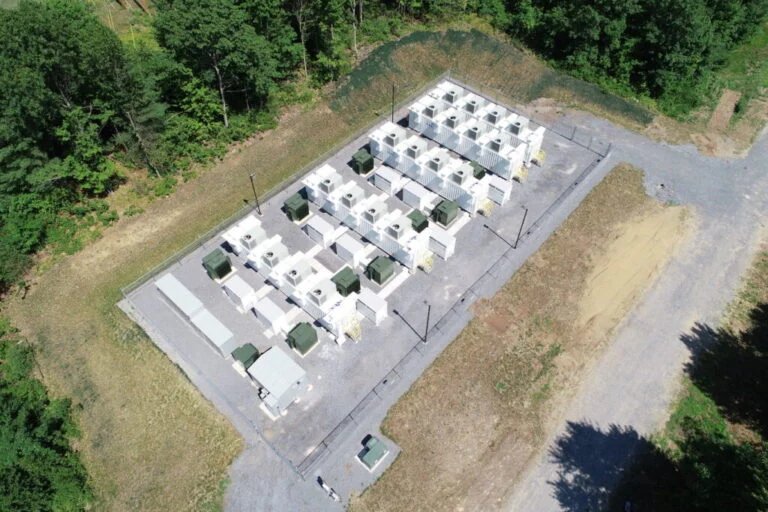
The Bulk Energy Storage RfP opened for applications in July 2025 and marked the latest destination on a long road for New York State to scale the deployment of large-scale energy storage, primarily new battery energy storage system (BESS) facilities.
NYSERDA had been ordered to create the programme by the New York Public Service Commission (PSC) under the state’s Energy Storage Roadmap 2.0. The 2024 roadmap outlined New York’s path to meeting its ambitious 6GW by 2030 energy storage policy target, after Roadmap 1.0, published in 2018, set out support schemes that delivered on Residential and Retail deployments but were less successful in the Bulk category.
Index Storage Credit aims to bridge gap to ‘missing money’ for developers
There have been various reasons cited for New York’s lagging adoption of utility-scale BESS, chief among them the wholesale market structure of grid operator NYISO, which does not allow for the kind of merchant revenues seen in more volatile electricity markets such as ERCOT in Texas, for example.
Various industry voices had commented that essentially, this left developers in New York with a ‘missing money’ problem. The new programme hinges on a contract mechanism called the Index Storage Credit, whereby NYSERDA sets a guaranteed strike price for playing stored energy into NYISO markets. If the project earns more than the strike price, stakeholders pay the difference back; if revenues fall below the strike price, NYSERDA pays a top-up. In this way, it is hoped that developers and investors can have some revenue certainty without putting New York ratepayers out of pocket.
Payments begin once the projects have begun commercial operation. The projects are expected to be placed in service by the end of 2030. One aspect of the solicitations that the wider world may be watching closely is how New York is tackling concerns over the fire safety of battery storage. State Governor Kathy Hochul formed the New York State Inter-Agency Fire Safety Working Group in 2023 in response to concerns of residents and communities, and changes were made to the New York Fire Code a year later based on the group’s proposals. The revised codes have been applied to the Bulk Energy Storage solicitation.
Eight projects selected in first annual RfP
NYSERDA selected winning BESS projects as follows. The agency did not attach names of developers to the contracted portfolio announcement, and so some of the following information is based on Energy-Storage.news research.
It appears that developers Flatiron, Key Capture Energy, and Grid Connected Infrastructure (GCI) each won contracts for two BESS projects, while Savion and Zenobe each got one project.
| Region | Project | Developer | Location | Output (MW) | Capacity (MWh) |
| Western New York | Lighthouse Energy Storage | GCI (co-bidder Neoen) | Chautauqua County | 250 | 2000 |
| Western New York | Zenobē Burns | Zenobē | Allegany County | 100 | 400 |
| Finger Lakes | Eastwater Energy Storage | GCI | Monroe County | 100 | 400 |
| Mid-Hudson | KCE NY 5 | Key Capture Energy | Ulster County | 94 | 376 |
| New York City | Blue Spruce Storage | Flatiron Energy | Bronx County | 133 | 532 |
| New York City | Palladium Storage | Flatiron Energy | Bronx County | 123 | 492 |
| Long Island | Holtsville Energy Storage | Savion | Suffolk County | 110 | 440 |
| Long Island | KCE NY 37 | Key Capture Energy | Suffolk County | 150 | 600 |
“New York just took a major step toward the affordable, reliable grid our state needs,” William Acker, executive director of trade association and technology accelerator NY-BEST, said.
“NY-BEST applauds Governor Hochul and NYSERDA for this important milestone in the state’s first bulk energy storage procurement. These projects will strengthen the grid, lower costs, and help meet New York’s growing electricity demand.”
The table above has been amended from its original form to reflect that Lighthouse Energy Storage is an 8-hour duration project, unlike the other seven awarded projects, which are all 4-hour.