Farming and solar energy share something fundamental: they both depend on land, sunlight and long time horizons. A solar array generating power for 25+ years and a farm stewarding the same ground for generations are not adversaries. They are natural partners.
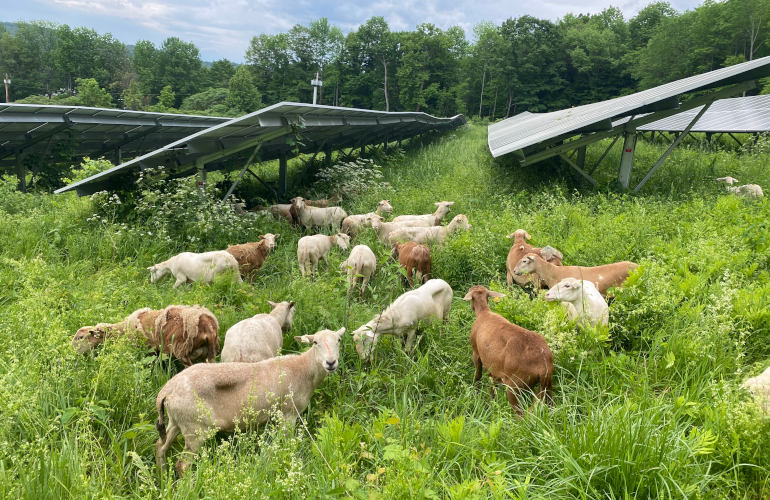
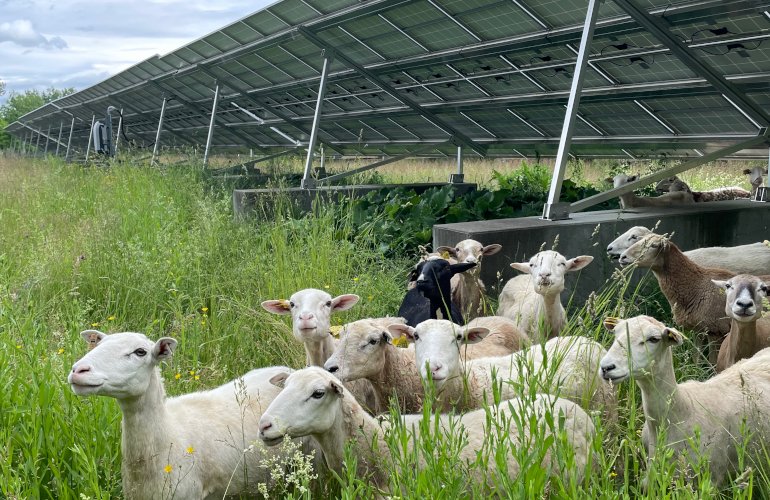
Sheep on an agrivoltaics installation. Credit: Encore Renewable Energy
This partnership, now referred to as agrivoltaics, is one of the most promising tools available for keeping working land in production while meeting the energy demand straining every grid in the country. SEIA’s new Prime Farmland Land Use Map shows that for every acre of prime farmland under solar, there are 43 acres of abandoned prime cropland sitting idle.
The American Farmland Trust’s “Farms Under Threat” research finds that the dominant threat to American prime farmland is low-density residential development, not solar. Nationally, golf courses occupy 2.6-times as much prime agricultural land as solar, and suburban sprawl since 2014 has consumed it at twice the rate of solar development.
Solar is not the threat to farms that the public debate assumes. In many of the places where I work, it is what keeps farms alive. I have never seen a developer take land out of active agricultural use and convert it to solar. As energy demand continues to soar, policy intended to drive agrivoltaics keeps making the same mistake — not the wrong premise about who the enemy is, but the wrong assumption about what agrivoltaics is.
One definition, too many boxes
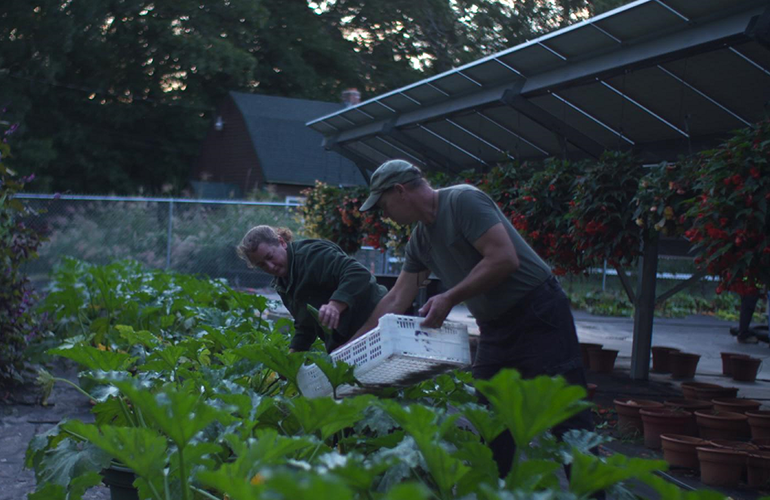
Crops growing among solar panel rows is also considered agrivoltaics. Credit: Green Development
A flock of sheep grazing under solar panels, a farmer harvesting crops between rows of modules, and a rancher running cattle under a dynamic racking system that tables to clear the herd are all doing something called agrivoltaics. They have almost nothing else in common.
The sheep need standard racking and a grazing contract. Co-located crops need a farmer committed years before the first harvest and an appropriately designed system. Larger livestock might need racking considerations and a model that understands potential production loss from design constraints. These are fundamentally different activities with different capital requirements, risk profiles, timelines and levels of agricultural ambition.
Virginia’s new definition, enacted this June, is a meaningful step forward because it appears to be broad enough to capture all of them. But a definition is an umbrella, not a framework. Every state that has tried to build on top of a definition has made the same mistake: one set of rules for everything. Rack-height mandates that are sized for crops nobody was growing serve as one example. That approach has failed. What states need is a multi-course menu that matches incentives to the agricultural ambition and activity appropriate for the land.
What the menu looks like
Agricultural deployment alongside solar spans a wide range of activities, but they tend to cluster into three broader buckets: livestock, crops and ecosystem services, each with its own economic profile and, in turn, its own natural policy fit. A single instrument or policy will be wasteful at the low end of this spectrum and insufficient at the high end, so the incentive structure needs to track the economics across all three. The examples below are illustrative, not comprehensive:
- Livestock ranges from smaller animals and remote grazing up through larger cattle and newer pairings with chickens or forage-based pigs. Sheep grazing sits at the proven end: it’s the most established agrivoltaics activity nationally, with 130,000 acres already under active grazing, manageable incremental costs (forage, fencing, water, a grazing contract) and no racking modifications required. Because the practice is already so well-established, what matters most here isn’t financial incentive but the certainty described below, assurance that the rules won’t shift beneath a 25-year asset. At the other end sit larger cattle, which can be integrated with specific racking considerations or, in some instances, standard racking over well-managed herds. That configuration can mean absorbing an ongoing energy yield loss rather than just an upfront premium, which tends to call for stronger policy support, something like a premium power purchase price or direct yield-loss compensation.
- Crops range from retrofitted shade-tolerant applications, to systems proactively designed around a specific crop, to buffer zones outside the fence line but still within the parcel. Shade-tolerant, hand-harvested crops like leafy greens, herbs and brassicas need no racking changes but carry real soft costs: contracting a farmer years before first harvest, carrying their compensation through construction, insurance, a management plan, the kind of profile a timeline-bridge fund or forgivable loan may fit better than a tax credit. Standard crops requiring specific rack height and row spacing add a structural premium on top; research puts elevated crop-compatible systems at 20 to 50% more per watt than standard ground-mount, pointing toward a timeline bridge and hardware incentive alongside the same early tax-status certainty discussed below. Specialty and intensive crops often perform better under panels than in open fields but need sophisticated design and years of investment before revenue materializes, suggesting an income bridge paired with a production incentive tied to documented crop sales. Retrofitting and utilizing the buffer zone can require new permits to account for any changes to stormwater management.
- Ecosystem services treat pollinators less as a standalone amenity and more as a cover crop, one that can support regenerative agriculture and serve as the foundation for bringing fallow farmland back into production, or creating new farmland altogether. Pollinator habitat with real ecological rigor (species surveys, adaptive management, third-party monitoring, sometimes beekeepers) costs meaningfully more than a seed mix alone and requires financing mechanisms to help close that gap. At the far end sits the hardest economics on the menu: revitalizing abandoned prime farmland, where land preparation, soil amendment and long pre-revenue timelines stack on top of everything else. That case likely needs the fullest support stack of any: upfront funding, tax credits, CRP-equivalent recognition for the establishment period and the strongest regulatory certainty available. This allows solar to serve as the economic bridge that makes the farmland viable again.
None of these buckets are watertight. A well-designed framework has to flex for projects that draw from more than one bucket at once; a site pairing sheep grazing with pollinator corridors and a shade-tolerant crop needs to be able to capture the full value of all three. That kind of layering is increasingly where the field is heading.
Project certainty at no cost to the state
Across the spectrum, the most valuable things a state can offer cost it nothing. The first is agricultural land status protection: a guarantee that land qualifying for use-value tax assessment retains that designation for the life of the array, regardless of solar lease income.

Pollinator-friendly arrays like this one in Southern Ohio can also be agrivoltaics. Credit: TMI Electric
Without it, a solar lease that makes farming viable can simultaneously trigger a property tax reassessment that undercuts the economics. Maryland has already addressed this directly, creating a pre-construction binding determination process that locks in agricultural tax assessment status before a project is built, giving developers a benefit they can price into their financing from Day 1.
The second is permitting certainty: a binding pre-construction determination that the project qualifies as agrivoltaics, combined with statutory insulation from future changes to compensation, siting requirements or agricultural designation rules. Together these function not as subsidies but as a contract. The state commits to holding the ground stable. The developer commits to agricultural activity, documented and enforceable. A mutually beneficial agreement is implemented from day one.
Virginia is also moving in this direction. A bill that would have added agrivoltaics to the Commonwealth’s right-to-farm statute, giving qualifying projects the same protections afforded to other agricultural activities, was introduced this session and continued to 2027. The definitional groundwork laid by SB340 and HB508 makes that next step more viable: legislators will have criteria to point to, a working group building out the standards, and a growing body of evidence from projects already operating in the Commonwealth.
Communities can trust agrivoltaics when they can see what a project has committed to deliver. Developers can invest when the criteria are clear before construction begins. Farmers can participate when the framework respects that agriculture is as varied as the land it happens on, the people who work it, and the markets they serve. American farmers have never relied on one crop, one market or one revenue stream to survive. They shouldn’t need one definition of agrivoltaics either. Build the menu with room for all of our farmers to participate.
Lauren Glickman is Vice President of Policy and Communications for Encore Renewable Energy, a leading solar developer and Certified B Corporation headquartered in Burlington, Vermont.