One day last June, as Congress considered rolling back elements of the Inflation Reduction Act, a group of clean energy industry executives visited Capitol Hill to make the case for a “soft landing” of critical tax provisions.
While the advocates sought to move with the currents instead of against, their messaging would prove as pragmatic as their efforts futile.

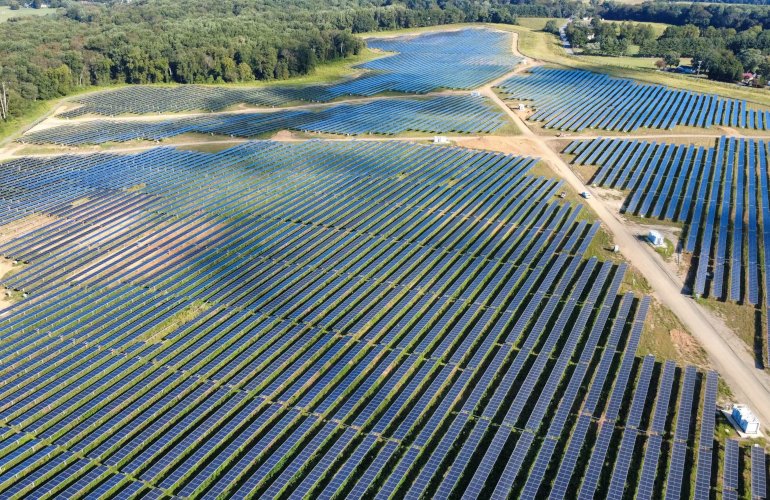
A Madison Energy project in Maryland.
For all the growth and promise of solar and energy storage, our industry’s position on the legislative sidelines last summer highlighted just how outmoded and misguided our policy and political strategies have been for years. No single perspective or organization is to blame; it’s been collective underperformance marked by industry-wide underinvestment in our political processes and the errant prioritization of short-term incentives over long-term infrastructure and the pursuit of self-sustaining markets.
Fundamentally, the clean energy industry has often confused moral certainty with political durability — dedicating our time, talents and resources to advocacy on the merits of our arguments while failing to build a broader, stronger coalition capable of delivering lasting results within the context of realpolitik. Whereas our industry once stood on the precipice, begging for an invitation to the party as the self-branded “alternative” outsider, we have now firmly earned a seat at the table. Yet our approach to policy at federal and local levels hasn’t evolved and kept pace with our deployment.
Our economy and energy landscape have forever shifted. Gone are the days of an uneventful power grid and a set-it-and-forget-it approach to consuming, and paying for, cheap, abundant electricity. Aging, complex energy infrastructure, rapid data center growth, extreme weather and tightening capital markets have converged to create an untenable customer experience with record-high energy costs and outages. Welcome to the new normal.
With challenges come opportunity. Unprecedented load growth colliding with a power grid built for yesterday’s economy is a good story for clean energy and should only lower our pricing on a comparable level.
This is clean energy’s moment to realize our vision to build a dynamic ecosystem where capital, technology and, crucially, policy come together to modernize energy for industry and communities, where it matters most.
Despite the surging tailwinds that should have given way to greater temerity and confidence, we’ve made miscues in the political arena, from partisan coalition building (“eggs in one basket”) to crafting narratives rooted in academia (“cream rises”) and prioritizing myopic wins over lasting impact (“forest for the trees”). We’ve treated politics as brand alignment rather than power management and have assumed our desired outcomes would follow from our being right, innovative or inevitable, rather than from organizing, trading and governing.
The One Big Beautiful Bill Act’s passage, the asymmetry of political machinery between our industry and other entrenched energy sectors and ineffective campaigns at the state level — California community solar and egregious, retroactive changes to settled programs in Maine and Minnesota to name a few — have laid bare the need for change.
We must remain laser-focused on deployment and avoid the missteps of seeking to blend unrelated social initiatives into our campaign. Asking for too much can result in nothing; more often, good enough is plenty good.
We must stop optimizing for being right and start operating from a position of strength and resilience, taking the long view just like the steel we put in the ground.
We must coalesce around thematic messaging crafted for evergreen growth, business and affordability movements: American power abundance and cheap electrons for a new dawn of industrial might, manufacturing, compute, security and reliability.
We must anchor our state-level engagements first and foremost with a zero-tolerance approach to any and all proposed retroactive changes to already-passed laws and contracts. Flip-flopping and going back on regulatory certainty is un-American and anti-capitalist.
We must stop thinking and, worse, operating with embedded short-termism in local and regional markets. Pursuing hand-to-mouth megawatt allocations, rebate-heavy programs and financially unsustainable legislation is the antithesis of the market-oriented, self-sustaining public policies we know we need to thrive for decades to come.
We must build a deeper roster of validators. Name checking the “AI arms race” isn’t enough. We are quite literally filling the electron gap our partners across the economy are facing, both on the supply side with load serving entities such as municipal utilities, co-ops and IOUs, and with the demand-side commercial and industrial customers and communities who have always understood the economic advantages of clean energy.
We must stop talking like an industry and start talking like infrastructure. Airports don’t message like a cause. Neither should power plants.
The good news? Our industry, as always, continues to adapt, change and deliver results with bold ideas, creative organizing and shrewd politicking already underway.
Clean energy doesn’t need to become less ambitious. We need to become less fragile and a partner to both sides of the aisle. We should sell the universal benefits of our innovation (savings and stability powered by the sun and batteries) and de-emphasize the esoteric features our industry lives in day to day.
If we want public policies that last, we must earn it the way every durable American industry has previously: by building a coalition that is geographically broad, culturally legible, and politically inconvenient to ignore. That means prioritizing our customers and the communities we serve above all else; showing up in counties of all stripes and colors; talking about power abundance and price certainty, and investing in relationships that don’t depend on who wins the next election.
The future won’t be secured by the purity of our arguments. It will be secured by the tenacity and breadth of the winning coalition we choose to build.
 Cameron Bard leads business and market development for Madison Energy, overseeing sales, marketing and customer success to deploy more clean energy and build stronger communities. Cameron has spent his entire career in clean energy and climate, holding senior leadership positions in the private sector and previously serving in state government, including in the New York State Governor’s Office as Chief of Staff to the Chairman of Energy & Finance. Cameron frequently lectures at colleges and universities and is an adjunct instructor at NYU’s Center for Global Affairs.