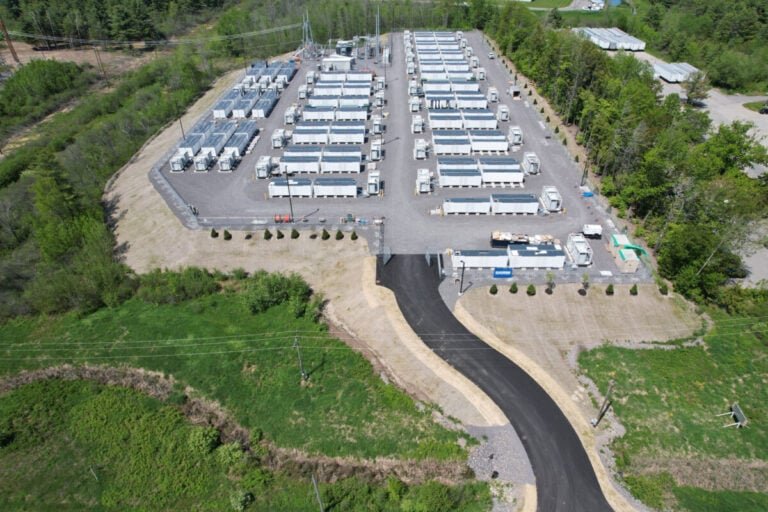
Duncan also said the BESS, located in Jackson County, Alabama, “will serve TVA’s operational needs and respond to its dispatch instructions.” It is not a merchant trading opportunity.
Under the agreement, TVA will charge and dispatch energy from Crawfish Creek based on system needs, while Plus Power’s Crawfish Creek Energy Storage retains ownership of the facility.
Crawfish Creek will also provide grid-forming capabilities, fast frequency response, regulation, and operating reserves, to help support growth in manufacturing, data centres, and industrial investment across the Tennessee Valley.
Construction on the project is expected to begin in 2028, with commercial operation anticipated in summer 2029. Plus Power claimed the project is expected to create 50 to 100 construction jobs in Jackson County and support four full-time operations roles once completed.
Plus Power also stated that Crawfish Creek contributes to TVA’s larger initiative to bring 6,200MW of additional generation capacity online in response to rising electricity demand throughout north Alabama and the Tennessee Valley region.
Over the last five years, TVA reports that its economic development initiatives have facilitated the creation of more than 91,000 new jobs, preserved 235,000 existing positions, and generated US$45.9 billion in anticipated capital investment across Alabama.
The news of the Crawfish Creek ESA came shortly after TVA and IPP Tenaska, through its affiliate Bobwhite Energy Storage, announced a long-term ESA for the 225MW/900MWh Bobwhite BESS project in East Tennessee.
Alabama and Plus Power
According to the US Energy Information Administration (EIA), approximately 9% of Alabama’s total electricity was generated by renewables in 2024. Of that 9%, hydroelectric facilities made up about 65% of renewables generation.
Approximately 25% came from biomass, mainly wood and wood-derived fuels, and 10% was generated by solar.
EIA also explains that Alabama’s strongest solar potential is concentrated in the state’s southeastern corner and along its brief Gulf Coast coastline.
The state’s inaugural utility-scale solar facility, a 30MW PV installation, commenced operations in late 2015 on the Alabama side of the Fort Benning US Army base. In late 2021, a 227MW solar farm in northwest Alabama became operational, representing the state’s largest solar project and providing electricity to a major data center.
Earlier this year, the US Department of Energy (DOE) closed a US$26.5 billion loan package with two wholly owned subsidiaries of utility Southern Company, in Georgia and Alabama.
In Southern Company’s Alabama-based subsidiary, Alabama Power’s 2025 integrated resource plan (IRP), the company considers traditional BESS and medium-duration energy storage systems (MDESS) with approximately 12 hours of duration.
The utility revealed Alabama’s first utility-scale battery storage project in March 2025, a 150MW system in Walker County that will occupy the former site of the Gorgas coal plant, which ceased operations in 2019.
A year earlier, EPRI, Southern Company, and Storworks wrapped up testing on a concrete thermal energy storage pilot project that was described as the world’s largest demonstration of the technology at that time.
In January, Southern Company announced plans to deploy technology from US-based iron-sodium battery manufacturer Inlyte Energy at its Energy Storage Test Site in Wilsonville, Alabama. The demonstration project is sized at 80kW/1.5MWh.
Plus Power stated that with Crawfish Creek, the company is entering its seventh state market and expanding into the Southeast. The company said that it currently owns and operates nine facilities in Arizona, Hawaii, Maine, Massachusetts, and Texas, totaling 1,650 MW/4,150MWh.
In February, Plus Power announced it had begun operating the 175MW/350MWh Cross Town BESS in Gorham, Maine, which according to the company, is the largest BESS of its kind on the ISO New England grid.