The solar industry is entering a new era where project success depends on more than equipment selection and installation expertise. As compliance requirements, domestic content rules and incentive qualifications become increasingly interconnected, installers must navigate a growing set of considerations that can influence everything from procurement decisions to project economics.
While tax incentives remain a key driver of growth, compliance is no longer simply a financial or regulatory concern. It has become an important factor in supply chain planning, inventory management and overall business strategy. Installers that proactively adapt to these evolving requirements will be better positioned to reduce risk, maintain project timelines and capitalize on future opportunities.
Understanding how these requirements affect sourcing, eligibility and project execution is becoming essential for long-term success in an increasingly complex solar market.
Understanding the benefits and new requirements

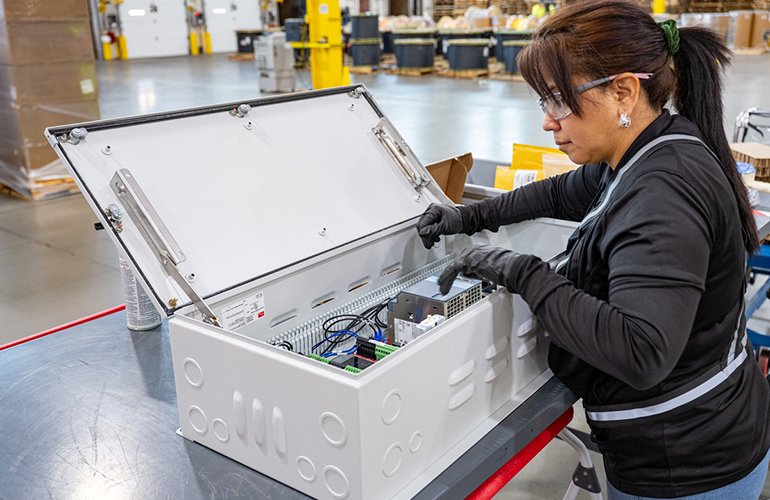
A combiner box is opened to its interior components. Credit: Wesco Energy Solutions
The One Big Beautiful Bill Act (OBBBA) introduced foreign entities of concern (FEOC) compliance requirements to qualify for the underlying 30% base tax credit for systems with maximum net output under 1 MWAC. The OBBBA also removed the residential tax credit for cash and loan purchases. To qualify for any tax credit, equipment must be FEOC-compliant. To get the 10% domestic content bonus adder, domestic content requirements must be met. The domestic content percentage requires a certain percentage of U.S.-made components — panels, inverters and racking.
Verification of FEOC-compliance is required, and manufacturers are now obtaining third-party prohibited foreign entity (PFE) letters to verify compliance with applicable sourcing and manufacturing requirements. To further add to the complexity, the allowable percentage of content from prohibited countries decreases annually, making compliance increasingly challenging.
Many widely available solar panels and system components don’t meet the domestic content threshold, leaving installers caught between incentive eligibility and product availability. The result is a growing strain on project planning as installers must now balance stranded inventory, constrained sourcing options and difficult trade-offs between cost, compliance and timelines.
Navigating this environment requires a shift in approach. It’s no longer just about securing panels — it’s about understanding how every component in a system contributes to compliance, and how the right supply chain and industry partnerships can help bridge the gap.
Strategies to combat sourcing challenges
With a limited pool of qualifying manufacturers, there is a slow emergence of two markets: one for tax credit-qualifying equipment that’s compliant, and another for lower-cost, non-qualifying, non-compliant equipment.
Despite the complexity, several manufacturers can often meet both domestic content and FEOC requirements. Partnering with them can help give installers peace of mind and avoid scenarios where inventory is later found to be non-compliant.
These unfortunate situations can cause major headaches for installers. The value of material drops, requiring price adjustments to remain competitive, as non-compliant material can still be sold but without tax credits. And, if a third-party owner (TPO) or installer uses non-compliant equipment, the IRS can reclaim tax credits years later, making due diligence and approved vendor lists critical for risk reduction.
Another way to help avoid these situations is to have a strong relationship with distributors that can secure compliant inventory and assure manufacturer compliance.
Industry impacts of regulation and what’s on the horizon
The residential solar segment is down compared to 2024, with the decline most pronounced among small- and medium-sized installers reliant on cash and loan deals. In tandem with this contraction in the residential solar market, there’s been an increase in TPO projects with large installers. These projects operate with a financing model in which a third party owns the solar system and typically claims eligible tax incentives. While TPO projects are less affected by the downturn, there can be geographic variability. Some states lack TPO options due to low solar adoption or utility rates, making cash and loan deals the only viable path. In these cases, market strategies must be tailored to local conditions.
While the new regulatory environment has posed challenges for small installers, it has also introduced new financial products like prepaid power purchase agreements (PPAs) that can make projects more economical. With PPAs, a third-party owner claims the Section 48E clean electricity investment tax credit, which is provided under IRS code for investments in qualified clean electricity facilities and energy storage technology. This tax credit can be 30% or more of the value of the investment.
While the tax credits for solar projects wind down, batteries remain eligible for tax credits through 2030. Even if solar credits expire earlier, batteries are a significant portion of project costs.
What installers should do now
As compliance requirements become more tied to project economics and equipment sourcing decisions, installers should take a proactive approach to managing risks.

A distributor inspects a combiner box. Credit: Wesco
Compliance considerations should be part of project planning from the outset rather than addressed during procurement. Understanding eligibility requirements early can help avoid costly redesigns, delays or equipment substitutions later in the project lifecycle.
Equipment decisions are no longer based solely on price and availability. Installers should account for incentive eligibility, sourcing requirements and possible regulatory changes when evaluating products and suppliers.
Accurate records and supporting documentation can help streamline project reviews and support eligibility for applicable incentives and credits. Establishing clear documentation processes early can reduce administrative challenges later.
Given the pace of regulatory and legislative change, installers should work closely with qualified legal and tax professionals to understand how evolving requirements may affect project eligibility and financial outcomes.
Policy changes at both the federal and state level and the impact of tariffs have made future-proofing solar investments highly complex. The best defense is to stay informed and involved in policy discussions. For organizations that can adapt, there is still a clear path forward, but it demands sharper insight and stronger partnerships with manufacturers, distributors and key industry organizations.
Sean Grasby is a business leader with over 20 years of experience driving growth and strategic innovation across industries. He is currently the senior VP and GM of U.S. Construction at Wesco Energy Solutions. He was previously president of EECOL Electric, where he guided the organization’s strategic direction for the past five years.