
By Terence Parker, Compliance & Technical Training Specialist
America is entering what could be the largest expansion of electrical infrastructure since the modern grid was built. Rapid growth in electric vehicles, heat pumps, AI-driven data centers, and more is expected to dramatically increase electricity demand, potentially requiring two to four times the power the grid supplies today. Meeting this demand will require more than new power plants; it will require rethinking where and how energy is generated. One of the most practical and underutilized solutions may already exist in plain sight: parking lots.
In communities like our own here in Marshall, Michigan, where agriculture dominates the landscape, solar development has sparked debate. Large solar farms are increasingly being built on farmland, raising concerns about losing productive agricultural land. However, the situation is more complex. Much of the corn grown in the Midwest is used for ethanol production rather than food, meaning some solar projects are effectively replacing one form of energy production with another. Additionally, solar farms are not permanent land transformations. They require minimal soil disturbance, do not contaminate the land, and can be fully removed at the end of their lifecycle, allowing farmland to be restored.
Solar development can also coexist with agriculture. Through agrivoltaics, land can simultaneously support solar generation and farming activities. Vegetation, pollinator habitats, and grazing livestock, especially sheep, can thrive beneath solar arrays. Partial shading can even reduce water evaporation and protect crops from heat stress, making farmland more resilient.
Scale is another important factor. The United States has nearly 900 million acres of farmland, with about 200 million acres actively used for high-yield crops. Even a large expansion of solar by millions of acres would represent a relatively small portion of total agricultural land. Solar does not need to compete with farming. Still, a critical question remains: where should solar infrastructure be prioritized?
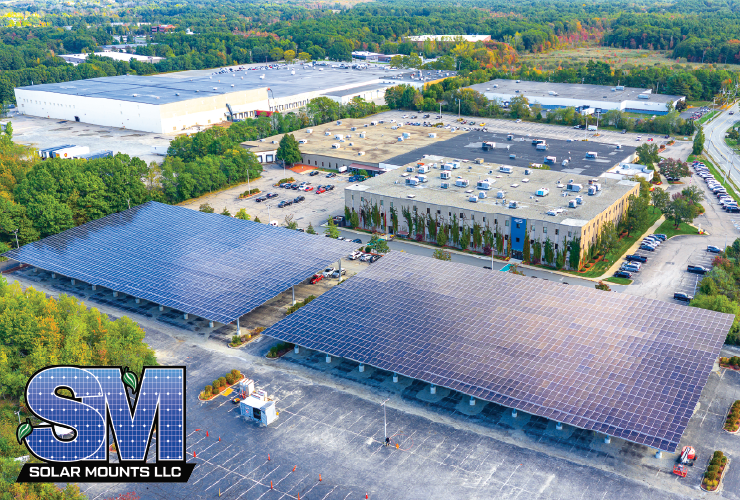
A compelling answer is parking lots. The U.S. has an estimated two billion parking spaces covering roughly 3,600 square miles of paved surface. These areas receive constant sunlight but currently generate no energy. Solar carports offer a way to transform this unused space into productive infrastructure. By installing PV carport canopies over parking areas, these systems generate electricity while providing shade and weather protection.
Even covering a fraction of existing parking lots could produce a significant amount of distributed energy. Offices, hospitals, universities, retail centers, and industrial facilities already have the space needed. Just as importantly, solar carports generate power closer to where it is consumed, reducing strain on transmission systems and improving efficiency.

While solar carports are more expensive to build than ground-mounted systems due to their structural requirements, they deliver a number of benefits that ground mounts do not. Property owners can turn parking lots into revenue-generating or cost-saving assets by offsetting energy use. For drivers, carports improve comfort by shielding vehicles from sun, rain, and snow. Cooler vehicles reduce air-conditioning demand and help preserve interiors. Electric vehicles benefit even more, as lower temperatures improve battery
efficiency and range. Carports can also integrate EV charging stations powered by on-site renewable energy.
Modern solar carports are engineered for durability and performance. They can withstand high wind speeds, meet strict seismic requirements, and can incorporate advanced modifications like LED lighting and fully waterproof designs. Increasingly, they are evolving into multifunctional infrastructure, providing protection, generating energy, and supporting broader energy systems.
This evolution is especially important as electricity demand continues to rise. AI data centers alone require enormous power, as a single server rack can consume as much electricity as dozens of homes. As these facilities expand, alongside electrified transportation and buildings, the grid will face unprecedented pressure.
To meet these challenges, the traditional centralized grid model is beginning to shift. Instead of relying solely on large power plants, the future grid is expected to function more like a network, similar to the internet, where energy is generated and managed across many distributed nodes. This concept, sometimes referred to as the “Enternet,” envisions a system where solar arrays, batteries, microgrids, and local energy hubs all contribute to a more flexible and resilient infrastructure.
Much of today’s technology already operates on direct current (DC), including solar panels, batteries, and data centers. This opens the door to more efficient energy systems that reduce the need for repeated AC-to-DC conversions. Some countries are already exploring this approach. South Korea, for example, has limited land for large solar farms and has turned to parking lots as a key solution. The country is actively promoting solar carports across commercial and public infrastructure. At the same time, it is modernizing its grid with high-voltage DC transmission and advanced microgrids. These systems distribute energy locally, integrate solar and storage, and improve reliability. In this model, solar carports serve as nodes within a decentralized, resilient energy network.
While a full transformation of the grid will take time, early signs are already visible. Distributed energy systems are expanding, and previously overlooked spaces like parking lots, rooftops, and brownfields are being recognized as valuable assets. Solar carports, in particular, offer a practical way to scale renewable energy without competing for land.
As energy demand grows and infrastructure evolves, parking lots may become some of the most important real estate in the energy transition. What was once passive space could play a central role in generating and delivering electricity. Solar carports are not just shade structures; they are a bridge toward a more distributed, efficient, and resilient energy future.
Sponsored Content by Solar Mounts