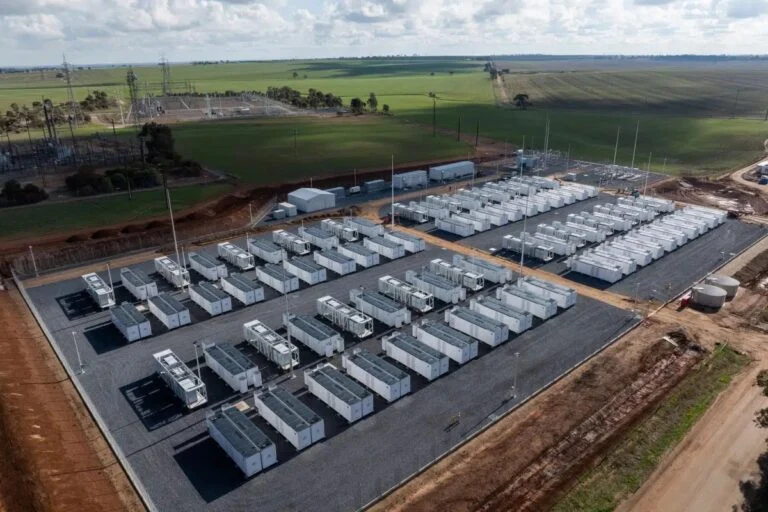
Of that total, 375MW and 3,000MWh are required to be operational by November 2028, with a further 142MW and 1,136MWh due by November 2029.
| Tender Category | Facility Name | Proponent/ | Technology | Committed Nameplate Power Output (MW) | Committed Storage Capacity (MWh) | Power Output (MW) | Storage Capacity (MWh) |
|---|---|---|---|---|---|---|---|
| 1 | Goyder Battery Stage 1 | Neoen Australia | BESS (Lithium-ion) | 75 | 600 | 200 | 800 |
| 1 | Goyder Battery Stage 2 | Neoen Australia | BESS (Lithium-ion) | 75 | 600 | 200 | 800 |
| 1 | Northern Battery | Ampyr Energy | BESS (Lithium-ion) | 125 | 1,000 | 270 | 1,080 |
| 1 | Tungkillo BESS | Iberdrola | BESS (Lithium-ion) | 100 | 800 | 270 | 1,080 |
| 2 | Brinkworth BESS | Akaysha Energy | BESS (Lithium-ion) | 92 | 736 | 250 | 1,000 |
| 2 | Dartmoor BESS | ZEBRE | BESS (Lithium-ion) | 50 | 400 | 144 | 576 |
| Total | N/A | N/A | N/A | 517 | 4,136 | 1,334 | 5,336 |
The six successful battery storage projects
Four projects were awarded in Tender Category 1, targeting the 2028 commercial operation date. Neoen Australia secured two FERMA contracts for its Goyder Battery project in South Australia’s mid-north. Stage 1 and Stage 2 each carry a committed power output of 75MW and a storage capacity of 600MWh, with a combined nameplate of 400MW and 1,600MWh.
Ampyr Energy’s Northern Battery rounds out the Category 1 cohort with a 125MW committed output and 1,000MWh, against a 270MW/1,080MWh nameplate, while Iberdrola’s Tungkillo BESS, a project the Spanish developer acquired from RES Australia in 2025, contributes a further 100MW committed and 800MWh, with a 270MW/1,080MWh size.
The two Category 2 projects, targeting November 2029 operations, were awarded to Akaysha Energy’s Brinkworth BESS, with a 92MW committed output and 736MWh against a 250MW/1,000MWh nameplate, and ZEBRE’s Dartmoor BESS, with 50MW committed and 400MWh against a 144MW/576MWh nameplate. All six projects use lithium-ion battery technology.
Successful projects entered into FERMAs, 15-year contracts that provide revenue certainty to support investment in long-duration capacity while requiring projects to meet performance obligations during periods of system stress.
ASL, which was appointed as the independent Scheme Administrator for the FERM in late 2025, said the tender attracted robust competition and that successful bids performed strongly against key assessment criteria.
The SA FERM scheme’s Financial Vehicle, established in February 2026 to hold scheme funds and act as counterparty to FERMAs, will administer the contracted agreements.
Nevenka Codevelle, CEO of ASL, said the results establish a foundation for the broader scheme.
“The tender attracted robust competition, with successful projects performing strongly against the key assessment criteria. ASL’s evaluation prioritised projects with a clear and credible pathway to commercial operation, a meaningful contribution to system reliability, and strong value for SA electricity consumers,” Codevelle said.
FERM mechanism framework and context
The tender opened in October 2025 with a 700MW target across three categories: 400MW by November 2028, 200MW by November 2029, and 100MW by November 2033.
Projects are required to demonstrate a minimum power output of 30MW and the ability to dispatch continuously for at least 8-hours.
The mechanism is technology-neutral, with coal and nuclear explicitly excluded as eligible fuel sources. The tender was also structured to accommodate aggregated facilities and hybrid configurations combining technologies under a single FERMA.
The FERM framework represents South Australia’s response to identified reliability gaps in the National Electricity Market (NEM) as thermal generation retires and renewable energy capacity expands.
Successful FERM projects receive capacity commitments providing revenue certainty for long-duration storage investments, combining competitive tender processes with long-term contracts to attract private investment in firm capacity infrastructure essential for grid reliability during renewable energy integration.
ASL’s general manager commercial, Thimo Mueller, recently told ESN Premium that cost declines in lithium-ion technology were delivering competitive pricing even for long-duration applications traditionally seen as the domain of alternative chemistries.
The SA FERM Tender 1 results were delivered within what ASL described as a compressed timeframe, with registration opening in October 2025, bids closing in late November, and outcomes announced in late May 2026.
Interested in Australia? Read Energy-Storage.news’ Energy Storage Summit Australia coverage and related content.