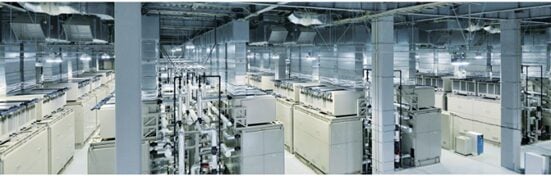
The Sumitomo Electric VRFB, the company’s third large-scale installation in Hokkaido, will also further the ‘Zero Carbon City’ goal of Abira City, where HEPCO’s Minami-Hayakita substation is located.
The project is scheduled for completion by the end of May 2029. Sumitomo Electric will be responsible for operations and maintenance (O&M) post-commissioning under a 20-year long-term service agreement (LTSA). It will also handle decommissioning at the end of the flow battery’s lifecycle.
Flow battery electrolytes are stored in liquid form in large tanks separate from the power stack, unlike lithium-ion (Li-ion) batteries, in which the energy is stored in the metal electrode.
As detailed in a recent ESN Premium feature article, this means flow batteries are considered safer and more durable than their Li-ion counterparts, as they are capable of many thousands of cycles with very little capacity degradation over time. The liquid electrolyte tank design also means their stored energy capacity (MWh) can be increased by expanding the size of the tanks.
Third Sumitomo Electric flow battery for Hokkaido
In 2015, Sumitomo Electric deployed what was at the time the world’s biggest vanadium flow battery system in Hokkaido, a 15MW/60MWh project for HEPCO. Although it has since been dwarfed in size by some more recent projects in China, it remains among the biggest to date and Sumitomo Electric’s single biggest deployment in a portfolio of more than 200MWh.
Seven years later, Sumitomo Electric engineers braved pandemic construction conditions to complete work on another VRFB in Hokkaido, this time a 17MW/51MWh asset completed in early April 2022.
Partly due to its relatively low population density, Hokkaido was one of Japan’s major hotspots for renewable energy development following the country’s push for clean energy after the 2011 Great East Japan Earthquake.
However, its limited grid interconnection with Honshu, Japan’s main island, and the variable nature of renewable generation, led to grid curtailment. In 2016 HEPCO became the first system operator in the country to mandate the deployment of energy storage technologies, although at the time this was with specific reference to solar PV plants over 2MW.
Sumitomo Electric said its VRFB was selected through the tender for reasons including a long service life, a high level of safety and environmental performance, and a proven track record, including its earlier Hokkaido projects.
In Spring 2025, the company became the first in Japan’s rapidly growing energy storage market to deploy a VRFB that will play into energy trading opportunities, a few months after announcing the first VRFB project to be approved for a government Capex support scheme for battery storage.
It also deployed what is still the biggest publicly announced vanadium flow battery plant in the US, a 2MW/8MWh system in California, in 2017.