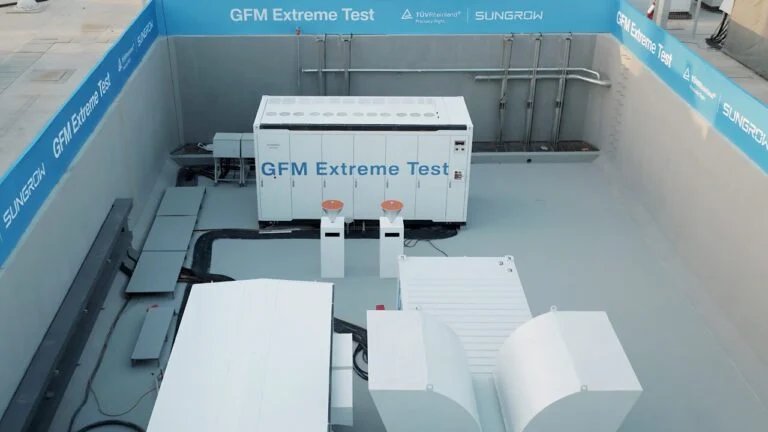
The blackout test saw the PCS establish system voltage within 19 seconds before restarting the facility, restoring loads without external support.
Sungrow said it is the world’s first such testing facility, where it proved the capability of its hardware to provide grid services under multiple conditions.
Henry Liu, general manager of Sungrow’s Microgrid and Grid Solutions Centre clarified to Energy-Storage.news that the results of testing at the 30MW grid platform were scalable and that response times remained relatively consistent, though increasing with system size.
These tests, according to Sungrow, align with grid codes and requirements across major global markets, including Europe, Australia, and China, addressing growing challenges related to grid stability and high renewable penetration worldwide.
Video of the testing, witnessed and verified by TÜV Rheinland, was presented at the company’s Global Renewable Energy Summit, hosted at its Hefei, China headquarters. Representatives from Sungrow were keen to emphasise the third-party attendance at its test facility for the 138-hour testing period.
Another eleven tests including on/off-grid switching, load switching, and oscillation damping were also successfully completed.
The announcement from Sungrow is its latest effort to demonstrate a proactive approach to product testing, after its domestic battery storage system was the first such product to go through a Large-Scale Fire Testing (LSFT) procedure late last year.
More famously, in 2024 Sungrow was the first company globally to conduct a large-scale burn test that saw it deliberately combust 10MWh of its Power Titan 1.0 BESS, letting it burn for over 24 hours with no thermal runaway to other units.
Growing industry focus on grid-forming technologies
The summit drew attention to an increasing need for grid-forming capability, something being seen across global markets. Liu said that any energy system with over 20% renewable penetration will require grid-forming.
To that end, Sungrow will also make its Power Matrix inverter system available globally, with shipments to Europe beginning in 2027 following the necessary regulatory approvals. The system is already available on the Chinese market, and offers source-level grid forming which Sungrow said provides 24-hour solar PV generation (alongside co-located BESS).
Grid-forming is increasingly a demand of energy storage facilities that once operated more as backup generators, with BESS and modern inverters also providing inertia and the reactive power services that previously were provided by gas and thermal power plants.
When the Power Titan 3.0 launched, Ken Stewart, senior key account manager at Sungrow UK & Ireland, noted that the system has an in-built “capability”, “to future proof and augment” projects using the hardware, while PowerTitan 2.0, the predecessor product, had just grid forming “functionality”.
Around 74% of battery storage projects in Australia’s National Electricity Market (NEM) pipeline are confirmed to be equipped with grid-forming inverters, according to the Australian Energy Market Operator (AEMO).
The topic of grid forming saw several references to the blackout that affected much of the Iberian peninsula in spring last year.
Some suggest that more modern grid-forming technology on the grid would have helped Spain and Portugal prevent or mitigate the effects of the system failure. While Sungrow itself did not draw direct reference, many at the event did, suggesting that grid-forming technologies like those presented by Sungrow will be key to preventing future blackouts.