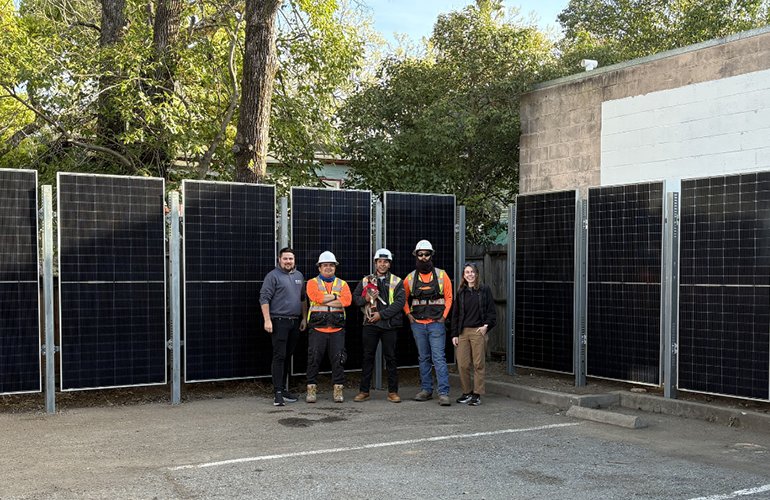
As urban density increases and commercial real estate becomes more constrained, so too can the space for solar PV in those settings. But by switching solar to a vertical orientation, it can still generate electricity in narrower project footprints.

Credit: Sunzaun
Earlier this year, racking manufacturer Sunzaun completed what it believes to be the first vertical bifacial solar installation in an urban commercial environment in the United States at Bodhi Hot Yoga & Fitness in San Rafael, California.
Co-owners Beau Keeve and Katie Egan built a business, and along with it a community, centered on wellness and movement. They run an all-electric business and have dealt with the mounting pressures of rising energy costs. Their monthly electricity bills climbed from a few hundred dollars to over $2,000 as infrared heating and humidity systems drew entirely from the grid.
With a structurally complex rooftop and a parking lot where every space mattered, conventional solar wasn’t an option. Sunzaun proposed rethinking their parking perimeter as a power source to transform a business liability into a sustainable asset through vertical bifacial solar.
The project is 16 bifacial panels, each standing between 8 to 9 ft tall, installed vertically along the perimeter of the studio’s back parking lot.
Rooftop space on urban commercial properties can be limited and structurally complicated. Zoning restrictions, shared building ownership and city permitting requirements add further friction. The result is that many urban businesses that want to go solar simply cannot access conventional installation pathways.
Why vertical and why bifacial?
Vertical bifacial solar is a proven concept in agricultural contexts in Europe, where panels are mounted vertically along field perimeters for dual land use. The technology works because bifacial panels capture light from both faces — direct irradiance on one side and reflected or diffuse irradiance on the other. Oriented on a north-south axis, they can generate meaningful energy throughout the day, with peak output shifted toward morning and evening hours rather than concentrated at noon.
What had not been demonstrated was whether this approach could work in a dense urban environment where buildings, trees and paved surfaces affect irradiance, and city permitting makes it more complex.
In Bodhi’s case, a section of the studio’s exterior wall adjacent to the panels was painted white to test whether surface reflection could meaningfully increase yield on the rear face of the bifacial modules. Early data on this variable will inform future urban installations where reflective surfaces — building facades, paved lots, painted walls — could be deliberately incorporated into system design.
“We’re the first, I believe … in an urban environment to do it in the U.S.,” Keeve said.
Practical lessons
The solar project at Bodhi was built in about 10 days, which was slightly longer than the original five-day estimate. The crew managed city permitting, utility coordination and site logistics without requiring significant involvement from the property owner.
“Designed to offset energy costs in a constrained urban setting, the system required precise integration with existing electrical infrastructure and careful site logistics,” said Craig Dinsdale, chief performance officer at Sunzaun. “Despite these considerations, construction progressed smoothly with minimal challenges.”
A key concern for any urban parking lot installation is space preservation. In this case, no parking spaces were lost. Protective bollards were added around the panel bases, and the final installation was described by the owners as an aesthetic improvement to the lot, functioning visually as a modern perimeter fence.
Projected annual savings for the studio from solar are estimated between $5,000 and $10,000.
Broader implications for urban solar
Urban commercial properties represent a largely untapped segment for solar deployment precisely because conventional approaches don’t fit their physical or regulatory constraints. Vertical bifacial systems offer a different pathway, one that uses perimeter space rather than rooftop space and can be deployed without disrupting day-to-day operations.
San Rafael is in Marin County north of San Francisco, and it is a community with strong environmental values, active fire season risk and a commercial corridor that’s becoming denser.
“We’re in this community for the longevity, and to see it prosper and grow,” Egan said. “Sunzaun helped put us on the map of putting our foot forward with that.”
Over the next 12 months, Sunzaun will monitor the Bodhi Hot Yoga, with particular attention paid to bifacial gains from the reflective wall surface, seasonal production variation and real-world savings against the pre-installation electricity baseline. That data will be published and shared with the industry.
Vertical bifacial solar is not a replacement for conventional rooftop or ground-mounted systems. But for commercial urban buildings, it represents a viable alternative.
The Bodhi Hot Yoga installation is proof of concept. The data will tell the rest of the story.