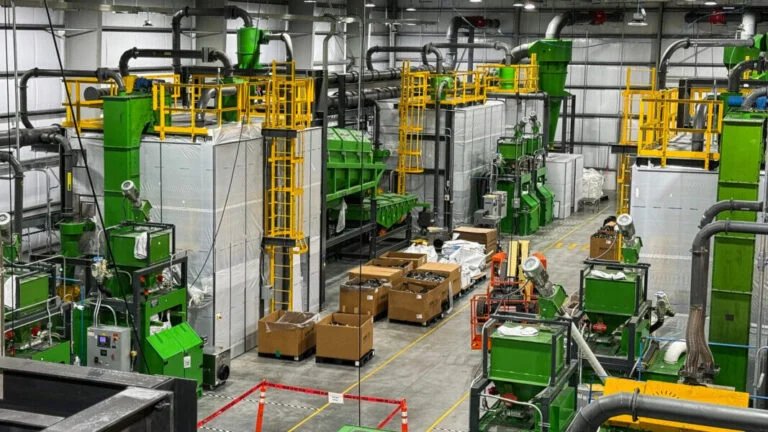
The news comes from an exclusive report by US blog TechCrunch, which claimed Redwood’s founder and CEO JB Straubel told remaining employees that “Redwood today is the strongest it’s ever been,” continuing, “The materials business is well on its way to profitability and has an exciting roadmap ahead.”
Energy-Storage.news asked Redwood for comment on the matter, a spokesperson for the company did not decline or verify any information but said the TechCrunch article covers the details the company is able to currently share.
Straubel highlighted the company’s new energy storage business in this move. Redwood launched its storage division, Redwood Energy, in June 2025, building on its primary recycling business that processes 20GWh of batteries annually.
The company repurposes second-life EV battery packs with remaining usable capacity for stationary storage applications, targeting hyperscalers, AI computing companies, and renewable developers who need massive power capacity deployed quickly.
In January, when Redwood closed the Series E financing round at US$425 million, Google joined as an investor, which Redwood claimed was a show of confidence in its battery energy storage system (BESS) division.
Redwood recently announced deals with data centre developer Crusoe AI to expand a partnership to scale renewables-powered AI compute and, earlier this month, US automotive manufacturer Rivian to supply second-life EV battery packs for deployment in an ESS at its manufacturing facility in Normal, Illinois.
Redwood said its initial 10MWh storage facility at Rivian’s factory will use more than 100 second-life EV battery packs from Rivian. The system is designed for rapid scaling and can grow with demand at the Normal site.
In his message, Straubel said “parts of the company have expanded faster than needed to support the direction” of Redwood. As a result, the company is cutting staff across multiple divisions, including engineering and operations, according to an employee granted anonymity to discuss the layoffs with TechCrunch.
Straubel further expressed confidence that Redwood can deliver on critical projects with a smaller, more focused team, noting the company has adapted to market changes that bankrupted competitors. He said he’s “more excited than ever” about building “the most integrated and cost-effective critical materials and energy storage business in the world,” calling it a self-sustaining operation with unique capabilities.
Redwood’s chief HR officer told affected workers the layoffs were made “to sharpen our focus, our work and the size of our teams” to align with the company’s future direction. The approximately 135 laid-off employees will receive severance, paid health benefits, and career transition assistance.
Ascend Elements files for Chapter 11 bankruptcy
Lithium battery recycler Ascend Elements filed for Chapter 11 bankruptcy protection earlier this month, with Linh Austin, President & CEO, describing the battery recycling industry as “capital‑intensive and complex.”
Austin wrote an article explaining the company’s current status. He joined Ascend in March 2025 knowing the company had a history of fiscal and operational mismanagement, but believed in its battery recycling technology and mission.
Despite assembling a “top” global team, securing over US$2 billion in commercial agreements and a US$320M grant in Poland, and streamlining operations, the financial issues proved insurmountable. He framed the Chapter 11 process as a proven tool to restructure liabilities and strengthen the balance sheet while continuing normal operations under existing management.
Austin emphasised that Ascend’s core mission remains unchanged: building a circular supply of critical battery materials using its patented Hydro-to-Cathode technology.
The company will continue operating its facilities, honoring customer commitments including its multi-year offtake agreement with commodities firm Trafigura, and advancing projects in North America and Europe.
He highlighted Ascend’s competitive advantage, as producing battery materials in a single step rather than traditional multi-step processes, achieving cost parity with Asian producers while cutting emissions by up to 90%. The CEO said its Georgia facility proved its process works at commercial scale in 2025, claiming to become the first US plant to produce 99%+ pure lithium carbonate from recycled batteries.
Austin outlined accountability metrics including continued commercial traction, successful facility ramp-ups in Kentucky and Poland, and demonstrated ability to replicate production lines. He positioned the restructuring as an opportunity to clarify direction and build a resilient battery materials supply chain that creates long-term value for employees, customers, and investors.
Ascend Elements said at the time that its supply deal, with an undisclosed “major US” battery manufacturer beginning in Q4 2024, would have an initial value of approximately US$1 billion but the contract had the ability to be expanded to be worth as much as US$5 billion.
In addition to the Georgia facility, it also planned an NMC pCAM facility in Kentucky.
In 2023, the company received two matching US Department of Energy (DOE) grants worth US$480 million to advance construction of the Kentucky facility.