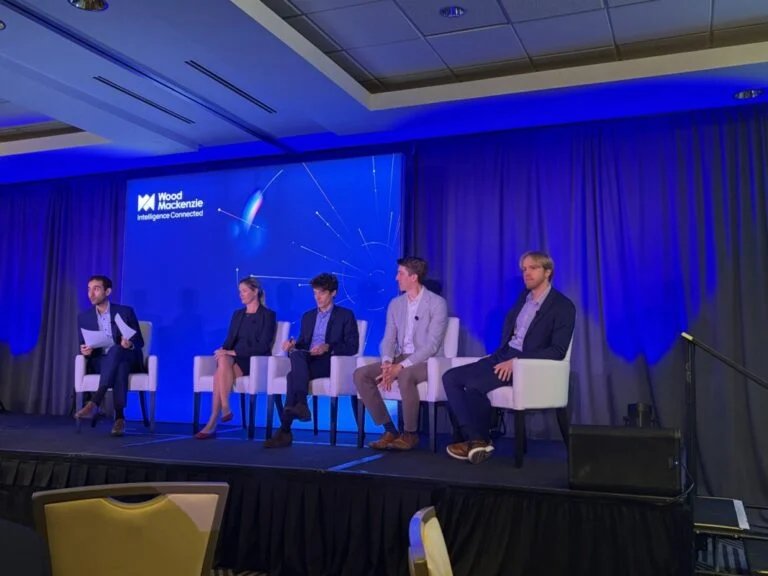
“Outside the Electric Reliability Council of Texas (ERCOT) market, obviously, although in ERCOT technically through various means, people want the capacity that storage brings,” Malin said. “For sure, there’s energy arbitrage revenues and ancillary revenues in certain markets. But everyone’s just obsessed with capacity.”
Pujol suggested that 60-80% contracted revenue has become standard for investment-grade projects, with the remainder left for merchant optimisation through ancillary services or trading.
Von Oesen confirmed this from a financing perspective, “Today you have to have some component of (a battery) contracted to get a significant amount of bank debt placed on any of these assets.”
ERCOT
The Texas market provided a case study in rapid market evolution. After adding 14GW of battery storage over five years, ERCOT has seen significant compression in volatility and merchant revenues during 2024-2025.
Panelists debated whether this represents a structural shift or temporary market conditions. Pujol leaned toward structural change, citing the volume of installed capacity. Others, including Lavoie, suggested markets will remain cyclical over time.
Potential load growth from data centres was mentioned as a variable that could restore volatility, though panelists noted that announced projects have not yet materialised at scale.
Operational complexity
Multiple panelists noted that battery storage has become significantly more complex.
“Five years ago, it was pretty much, you buy low, you sell high, and it’s almost as easy as operating a solar plant,” Pujol said. “But over the last five years, with the reduction of the spread, with the reduction of the ancillary services, it has become a much more complex asset.”
This complexity extends to contract structures, with tolling agreements and virtual battery products requiring specialised expertise. Pujol noted that Neoen has built an energy management team focused on quantitative modeling to optimise both bidding and operations.
Malin emphasised that operational execution matters as much as dispatch algorithms, “Although batteries are fairly straightforward technology, commissioning them and then operating them is not simple to do well.”
Von Oesn observed this complexity reflected in asset valuations. The price spread between notice-to-proceed and commercial operation date has widened significantly for storage projects compared to solar, due to commissioning challenges and potential delays.
Market opportunities beyond Texas and California
When asked about promising markets outside of ERCOT and California, panelists identified several regions:
PJM is seeing increased interest due to rising capacity prices. Lavoie described positive results from a behind-the-meter (BTM) project in Maryland providing frequency regulation.
New York, meanwhile, has implemented its Index Storage Credit (ISC) programme to provide long-term revenue certainty. However, Pujol noted that interconnection costs have caused more than 30% of tender participants to withdraw from the queue, highlighting the need for better coordination between procurement programmes and grid planning.
Ontario was cited as taking a grid-first approach, tendering 2GW of battery capacity before energy resources to ensure grid stability for future renewable additions.
Malin summarised the broader opportunity, “I literally can’t think of a place that doesn’t need storage.”
Policy and regulatory considerations
The panel discussed growing dependence on state-level incentive programmes, including New York’s ISC and Massachusetts’ Clean Peak Energy Certificate programme.
Malin also identified changing political administrations as a key risk, “The enabling legislation for some of these state programmes could be changed, or their implementation could be messed with if we have flips in the politics in a certain state.”
Lavoie pointed to tariff uncertainty and the complexity of navigating the standalone storage Investment Tax Credit (ITC) with Foreign Entity of Concern (FEOC) requirements as ongoing challenges.
Long-Term investment decisions
On the question of capacity over-building versus future augmentation, panelists generally favoured overbuilding despite higher upfront costs.
Pujol cited volatility for future augmentation and uncertainty about whether future battery technology will be compatible with existing systems.
Von Oesen confirmed that overbuilding is significantly easier to finance than projects relying on augmentation assumptions. This notion was shared by other BESS experts in March, during a discussion at the Energy Storage Summit USA 2026 in Dallas, Texas.
Five-year outlook
Looking ahead, panelists emphasised several trends including portfolio diversification, the popularisation of hybrid projects, operational capabilities as the primary source of competitive advantage and BTM opportunities potentially expanding with large industrial loads
Malin suggested that successful companies might evolve to provide operational services to off-takers, using their expertise to help contracted parties optimise BESS performance.
The consensus view was that battery storage remains essential across markets, but success increasingly depends on sophisticated risk management, operational excellence, and diversified revenue strategies rather than pure merchant trading.