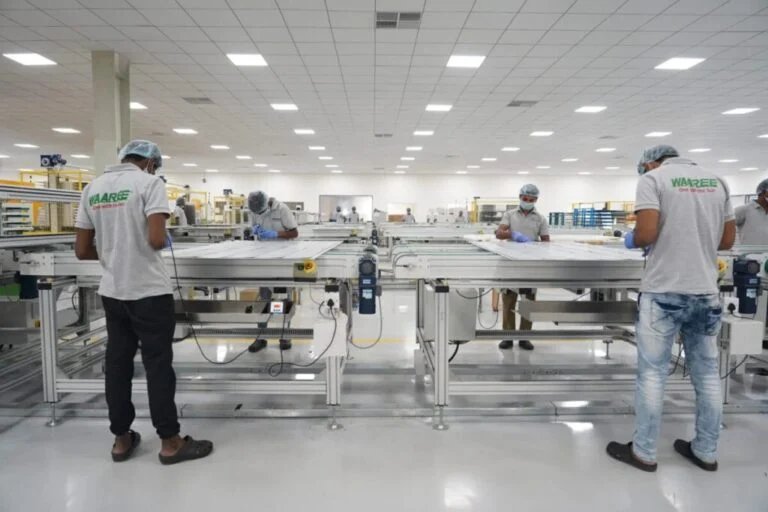
It features automated assembly lines, advanced testing and quality assurance (QA) systems, Automated Guided Vehicles (AGVs) and Industry 4.0 (i.e., smart and digitalised) production processes along with intelligent material handling, Waaree claimed.
20GWh manufacturing roadmap
Waaree did not mention the location of the factory in its releases, but it has been previously announced that the company is building a total 20GWh of BESS-related manufacturing in the state of Andhra Pradesh.
This includes battery cell and module production. Its parent company is also pursuing greater vertical integration in its solar business, investing in ramping up PV cell production to try to take a similar share of the market as it has in modules.
In January, Waaree Energy Storage Solutions raised INR10 billion (US$110.9 million) towards its BESS manufacturing plans. The company said it would cost a total of INR100 billion to reach the full 20GWh capacity, although at the time it had not revealed the planned split between component production capacities.
Yesterday, Waaree said that within the current financial year, it will operationalise 5.15GWh of battery pack manufacturing and 3.5GWh of annual lithium-ion battery cell manufacturing capacity.
The new BESS container plant joins a wave of new factories in India since the first units made at a production facility in the country rolled off lines operated by a Tata Power-Gotion High-Tech joint venture (JV) in late 2023.
Since then, Good Enough Energy announced a BESS enclosure factory with an initial production capacity of 7GWh, ramping up to 20GWh annual capacity. In May 2025, EV battery pack and BESS manufacturer Cygni Energy opened the first phase of a 4.8GWh plant.
However, activity further upstream in the more complex cell manufacturing space has been slower to take root. Earlier this year, India had around 60GWh of battery pack manufacturing capacity across the EV and stationary energy storage sectors, but only ~1GWh of cell production capacity.
According to a Guest Blog on this site by two experts at the Institute for Energy Economics and Financial Analysis (IEEFA), meeting 272GWh of projected battery demand in the 2030 financial year (FY2030) could incur an annual battery import bill exceeding US$23 billion.
The Union Government’s Production Linked Incentive (PLI) scheme, which offered Capex support for advanced chemistry cell (ACC) gigafactories has so far been largely unsuccessful. Just 1.4GWh of a 50GWh by 2025 target for cell manufacturing supported by the PLI was brought online, by one company, Ola Electric.
IEEFA analysts Charith Konda and Dhruv Garg wrote in their May Guest Blog that this was partly due to the scheme’s eligibility conditions, which included a high domestic content requirement for material inputs and a minimum bid size of 5GWh.
The IEEFA experts noted that there is instead a “parallel ecosystem” of non-PLI battery manufacturing efforts, citing Waaree’s 20GWh roadmap as one example alongside efforts from other players, including Tata, Amara Raja and Adani. However, the authors said that even this pipeline of around 76GWh is predominantly initially pack assembly, meaning that India will largely remain dependent on cell imports in the near-term.