During its recent investor event at the New York Stock Exchange, Corning Inc. set a target for its newly created Solar business unit: to achieve $3 billion in revenues by the end of 2030, as a key building block of the company’s long-term growth plan.
Yet, commentary from the solar industry following this key announcement was barely in evidence, with discussion largely confined to Corning’s equity sphere of reference.
With this $3 billion likely dominated by domestic U.S. sales, the details behind Corning’s Solar business plan need to be understood by the U.S. solar industry, as this could have a strong bearing on the overall PV manufacturing landscape out to 2030 and beyond.
However, other than the $3 billion number given by Corning, the company has provided the outside world with limited information on how this will be accomplished.
This article reviews how Corning could achieve its revenue run rate target for Solar by the end of 2030, seeking to explain what may lie within Corning’s internal business plan.
Corning’s definition of solar
Corning’s overall growth plan out to 2030 is referred to by company management as “Springboard.” This essentially maps out a growth plan for the company, moving from a year-end annual revenue run rate of ~$20 billion in 2026 to $30 billion in 2028 and then to $40 billion in 2030.
Therefore, while the term “springboard” has been used by Corning to highlight its overall growth strategy since 2023, the current version basically calls for a doubling of revenues between 2026 and 2030.
Within the Springboard strategy, Corning has recently created a new business unit called Solar. The goal is to grow Corning’s Solar year-end revenue run-rates to $2.5 billion in 2028 and then to $3 billion in 2030. By the end of 2030, Corning’s Solar business line is targeted to make up 7.5% of the revenues within an expanded $40 billion entity.
However, Corning’s Solar business unit has revenue contributions from markets outside the solar industry. This effectively reduces Corning’s solar PV ambitions to about $1.95 billion of annual run rate at the end of 2028 and $2.4 billion at the end of 2030. For reference, Corning’s solar PV run rate was in the range of $1.3-1.4 billion at the end of 2025.
Therefore, Corning’s five-year solar PV plan from 2025 to 2030 is to grow this part of the business with a 7.6% compound annual growth rate — a modest but not particularly aggressive goal.
Corning’s solar PV strategy today
Until 2025, Corning’s solar PV play was confined to the polysilicon output from Hemlock Semiconductor in Michigan, having assumed operational and financial control in 2020 following DuPont’s exit from the ownership structure.
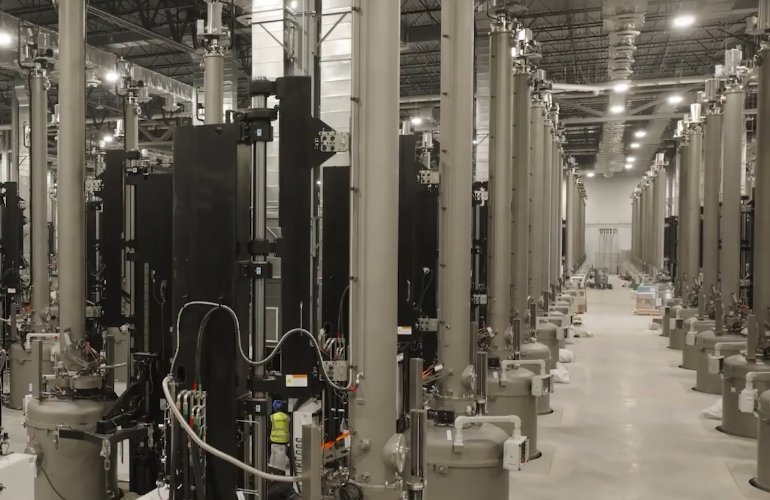
Corning’s next move in the solar PV industry was two-fold; announcing plans in 2024-2025 to set up ingot and wafer production through a newly formed internal vehicle and acquiring JA Solar’s module factory in Arizona through a separate entity. By the end of 2025, Corning had, in quick time, become the most fully integrated silicon-based solar PV producer in the United States and the first in the modern era of U.S. solar to produce ingots and wafers.
However, despite Corning increasing top-level targets of the Solar business unit to the end of 2030, precise details on how it intends to get there have not emerged.
Consequently, there are plenty of questions. How is this 2030 plan going to materialize? What will the product mix for solar PV look like by the end of 2030? However, perhaps the overarching question is, “Why?”
What is Corning looking to achieve with its new solar PV investments? Is the company intending to be a backend materials engine, largely detached from the end-market? Or does Corning want to “make a difference” in terms of technology roadmaps and innovation?
First, let’s build up a possible model of how Corning could grow its solar PV business to an annual run rate at the end of 2030 of $2.4 billion.
Selling polysilicon, wafers or modules?
With Corning’s existing allocation of polysilicon to the solar industry, the 2 GW of ingot and wafer capacity and the 2-GW module facility, it does not appear possible to reach the forecasted revenue run rate by the end of 2030 unless highly ambitious selling prices are assumed over this period with factories running significantly above nameplate capacity levels.
Therefore, the main question relates to the additional investment needed across the value-chain to allow for the uptick in revenues, compared to holding nameplate capacity levels static for five years. This is assuming polysilicon capacity for PV allocations stays flat out to 2030, as the goal is likely to maximize internal consumption of the existing output volumes. This implies that polysilicon will not be the primary growth for revenues.
Furthermore, increasing external wafer sales volumes to plug the gap would require a substantial increase of ingot/wafer capacity. Therefore, it can be assumed again that wafers will not be the driver, notwithstanding the relatively low production credits on offer here. However, this seems potentially at odds with Corning’s supply deals for wafers announced in the past 12 months.
The most obvious route to hitting the 2030 target for solar PV is to have a business model that is heavily weighted toward revenues from selling modules.
Therefore, the model developed assumes the addition of new capacity at the module level, with matching capacity added at the ingot and wafer stages. In term of phasing, this new capacity probably needs to come online in 2028, with capex committed during the second half of 2027 and the first half of 2028.
Consequently, by the end of 2028, Corning is forecast to have ingot/wafer and module capacity levels in the region of 4 GW each, allowing the company to meet its 2028 and 2030 targets.

Corning’s Solar business unit contribution to the company’s updated Springboard plan could see the main growth occur in the 2028-2029 period, potentially with the company doubling existing ingot/wafer and module capacity levels.
Looking now at Corning’s Solar business unit in more detail, the growth is coming largely from the PV-specific elements, in particular modules. The effect of seasonality is evident, making Corning’s annual forecasted volumes routinely lower than simply stating the annual run rates based on year-end sales.

Solar PV revenues are forecast to be the main driver for Corning’s Solar business unit, with seasonality in revenues a recurring theme.
The most interesting part of the model relates to the share of revenues coming from third-party shipments of polysilicon, wafers and modules.
Ingot production is assumed to use in-house polysilicon. A portion of the third-party wafer shipments for cell producers is based on a supply/return model, where only the net revenues are accounted for by Corning. This supports the rationale for the ingot/wafer stage essentially being part of flexible vertical-integration model from polysilicon to module.
However, if wafer sales to third parties are to offer a meaningful contribution to overall revenues, this would simply erode a greater part of the third-party polysilicon sales. In effect, the dominant revenue stream coming from modules would be largely unchanged.
The model shows polysilicon and module revenues similar in 2028, with the extra capacity added during 2028 increasing the module revenue share in 2029-2030. Therefore, by the end of 2030, Corning’s solar PV business is primarily being driven by selling modules; a significant change from 2024.

Corning’s revenues from its solar PV business activities are forecast to become module-dominant from 2029 onward.
The final part of the analysis relates to the capex needed over the next five years. The uptick in capex during 2025 came from the addition of the initial ingot/wafer capacity, while the company’s module facility was likely financed by JA Solar prior to the acquisition.

Corning’s capital expenditure for its solar PV manufacturing is forecast to see modest additions in 2027-2028 if the company is required to double its existing ingot/wafer and module capacity levels.
Capex during 2026 is seeing a somewhat unintended addition. Corning recently announced a shutdown of the ingot/wafer factory during Q2 2026, having put the equipment into mass production in the second half of 2025. The $30 million spend expected for this appears to have several inputs across repairs, upgrades and modifications; possibly also prompted by the changing technology mix in evidence across the U.S. cell production ramp phase in 2026.
The additional capacity needed for ingots, wafers and modules shows as an uptick in spending during 2027-2028, before declining to maintenance and upgrades during 2029-2030.
Positioning within the solar manufacturing ecosystem
Until now, Corning has largely “participated” in the solar industry as opposed to being a proactive agent of change. If the company’s 2030 plans are to simply add 2 GW more ingot/wafer and module capacity, while maintaining a business model that is dependent on third-party brands to sell modules to the end-market, this level of engagement is unlikely to change.
If module sales are to become the key factor in Corning hitting its 2030 targets, the emergence of a more customer-focused sales and marketing strategy is likely a prerequisite for success.
From a technology leadership perspective, the absence of solar cell manufacturing is the missing piece of the jigsaw for Corning. Polysilicon and wafers are the feed source for cell production; module production is the final assembly or packaging of solar cells.
Technology choice and market-share is determined by the process flows at the cell fabrication stage, with wafer and module producers having to adapt offerings based on the overall cell landscape.
A company’s plan to produce polysilicon, ingots, wafers, and modules within the United States, while relying on that same domestic market for revenue, carries inherent risk by skipping the cell-manufacturing stage.
Essentially, Corning’s strategy depends largely on the success of third-party U.S. cell makers, a segment currently comprised of newly formed entities or established cell and module proponents that may backward-integrate to wafer production in the United States by 2030.
Participation at the cell stage is therefore the fundamental decision that Corning will make over the next five years, in terms of how the company intends to engage with the solar PV manufacturing supply-chain in the United States. Choosing to remain decoupled from cell production essentially leads to a scaled version of the existing PV involvement.
Conversely, simply adding a 4-GW cell factory by the end of 2028 fundamentally transforms the company’s opportunities as a U.S. solar industry driving force to be reckoned with.
Borrowing from the company’s own narrative, this move would springboard its solar operations to one of technology leadership and controlling influence in the sector; more in line with Corning’s raison d’être as a technology innovator leveraging world-leading in-house research and development expertise.
Whatever way Corning chooses to develop its solar PV business to 2030, the solar industry is keen to learn more. If the strategy going forward does include plans to make solar cells, this anticipation would be even more exciting.