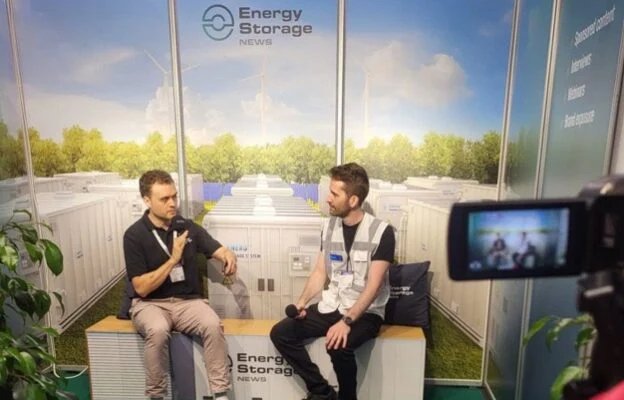
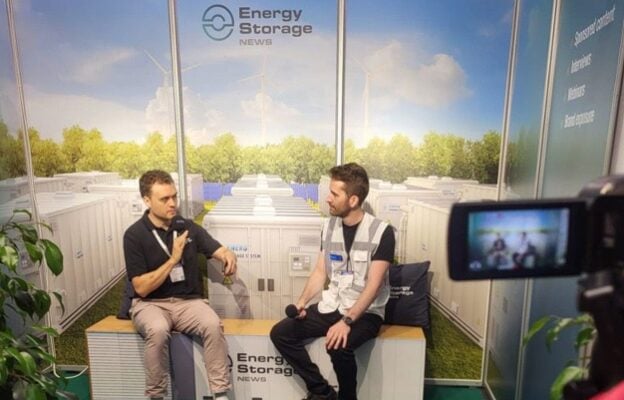
Sodium-ion BESS startup Moonwatt expects the battery chemistry to reach price cost parity with lithium iron phosphate (LFP) in the next two or three years, according to its CCO, Valentin Rota.
Speaking to us at the Smarter E Europe trade show in Munich, Germany, this week, Rota said: “We think LFP will stay a great chemistry for high-density front-of-the-meter (FTM) systems, while we think for our solar hybridisation applications, sodium-ion is a great fit.”
“And when we look at what’s to come on the roadmap we see further cost decreases for sodium-ion. We think probably within the next two to three years we should have a cost parity reached, which also means that in absolute levelised cost of storage (LCOS) terms, sodium-ion will be significantly more competitive than LFP.”
That is because sodium-ion (Na-ion) has a higher cycle life than lithium-ion, lithium iron phosphate (LFP) battery cells, reducing the cost per cycle, which forms part of the LCOS calculation.
This article requires Premium SubscriptionBasic (FREE) Subscription
Already a subscriber? Sign In
Try Premium for just $1
- Full premium access for the first month at only $1
- Converts to an annual rate after 30 days unless cancelled
- Cancel anytime during the trial period
Premium Benefits
- Expert industry analysis and interviews
- Digital access to PV Tech Power journal
- Exclusive event discounts
Or continue reading this article for free
Read Next
Executives from lithium-ion battery and BESS manufacturer CATL discussed sodium-ion technology at Smarter E Europe today.

Meridian’s Waiinu Energy Park has been referred for consideration under New Zealand’s Fast-track Approvals Act.
CATL held the global launch of its large-scale sodium-ion BESS yesterday, unveiling a 30MWh+ module which it will ship outside China from next year.
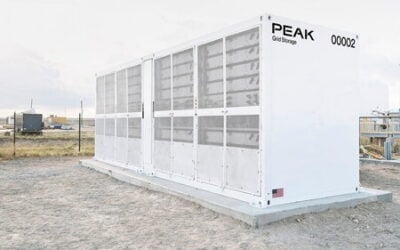
A group of sodium-ion (Na-ion) battery-focused companies have launched a new industry coalition, the American Battery Leadership Coalition (ABLC).
SK On’s North America president tells ESN Premium about the battery company’s vertically integrated push for market share across the US.
Most Popular
