By Ali Turner, Principal Writer and Content Strategist
As commercial and industrial solar continues to expand, exposed-fastened metal roofs remain one of the most practical platforms for photovoltaic (PV) deployment. But as more solar is installed on exposed-fastened roof profiles, one question is becoming more important for EPCs, installers, engineers and building owners alike: What makes a solar attachment ready for real-world rooftop conditions?
For years, rooftop solar mounting decisions have centered on speed, component count and compatibility. Those factors still matter. But the next standard for confidence goes beyond installation convenience. It is about verified waterproofing, repeatable installation quality and tested structural performance.
That is where Protea™ Bracket stands apart.

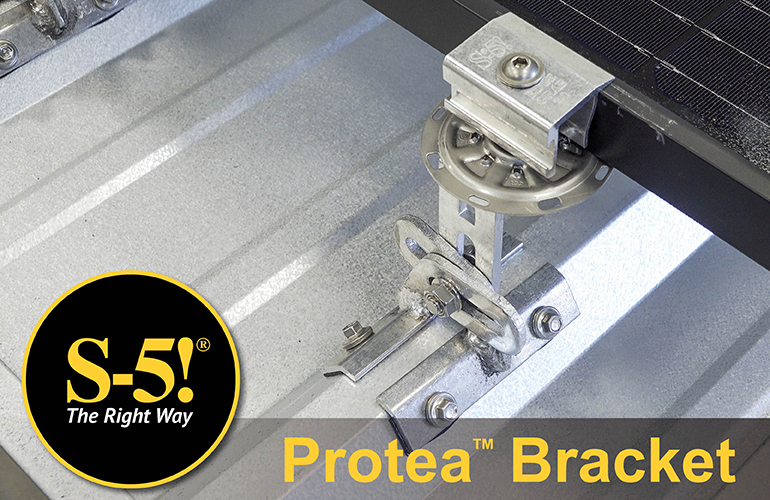
Protea Bracket with PVKIT rail-less solar mount.
Designed for rail-based and DirectAttach™ rail-less solar mounting with PVKIT®, Protea Bracket offers installers a versatile attachment solution backed by the testing and sealing performance the industry increasingly demands. On a roof, the smallest details matter. A bracket may look simple, but it is responsible for transferring loads, maintaining roof integrity and helping preserve long-term system performance. When multiple attachment points are installed across a project, consistency is not a luxury. It is essential.
One of the most important performance indicators is ASTM E2140 “Standard Test Method for Water Penetration of Metal Roof Panel Systems by Static Water Pressure Head,” the industry’s toughest watertightness test. This test helps answer a question every building owner cares about: Will the attachment remain watertight under demanding conditions?
That matters because exposed-fastened metal roof attachments penetrate the roof surface. When a fastener passes through the roof plane, the attachment must be engineered to help protect that opening from water intrusion. Passing a demanding water penetration test gives project stakeholders greater confidence that the mounting solution has been evaluated beyond ordinary claims of “weatherproof” performance.
For the solar industry, ASTM E2140 represents a higher level of accountability. It helps specifiers, engineers and contractors compare products based on tested performance, not assumptions. It also supports better conversations with building owners, roofing consultants and insurers who want to know that the solar attachment has been evaluated for long-term roof integrity.

Brackets undergoing ASTM E2140 watertightness testing to evaluate water penetration performance under static pressure.
Protea Bracket is also designed to simplify one of the messiest parts of exposed-fastened roof attachment: sealing. Instead of relying on field-applied sealants that can be inconsistent, time-consuming and dependent on installer technique or jobsite conditions, Protea Bracket uses factory-applied EPDM. That means the sealing material is already integrated into the bracket before it reaches the roof.
The benefit is straightforward: cleaner installs, fewer variables and less mess. Crews do not have to manage tubes of sealant across a hot roof, guess at bead size or worry about inconsistent application from one installer to the next. Factory-applied EPDM helps make the sealing process more repeatable, which can be especially valuable on large commercial solar arrays where hundreds or thousands of attachments may be installed.

Protea Bracket with rails on an exposed-fastened metal roof.
That repeatability can also support productivity. Solar contractors are under pressure to complete projects safely, efficiently and profitably. Reducing extra steps at each attachment point can add up quickly. A bracket that arrives ready to install helps streamline workflow while supporting the waterproofing performance the roof requires.
Structural confidence is equally important. Solar mounting systems must handle real-world forces over decades of service, including wind uplift, snow loads, thermal movement and changing environmental conditions. That is why load testing matters.
Load testing helps validate how the bracket performs across different conditions, substrates and installation scenarios. For engineers, that data can support a more confident design. For installers, it helps reduce uncertainty in the field. For building owners, it reinforces that the attachment was not simply designed to fit the roof; it was tested to perform on it.
In an industry where speed often gets the spotlight, verified performance is what supports the project after the crew leaves the jobsite. A solar array is expected to operate for decades, and the mounting system is the foundation of that investment. The right bracket should install efficiently, fit the roof profile, help protect against water intrusion and provide tested strength.
Protea Bracket brings those priorities together in one solution for exposed-fastened metal roofs. With ASTM E2140 water penetration testing, factory-applied EPDM and robust load tests behind it, Protea Bracket gives solar professionals a smarter way to mount PV with confidence.
As solar adoption accelerates across commercial metal rooftops, the industry should expect more from every component that touches the roof. Protea Bracket helps meet that higher standard.
Explore a Better Way to Mount PV
Sponsored Content by S-5!